 |
Peano
|
|
Peano
|
Functions | |
| List["peano4.api.solversteps.Step"] | translate_with_sequential (Graph graph, str identifier, "peano4.api.Project" peano_project) |
| Split tasks writing cell data into producer and consumer, and map each task onto its own mesh traversal. | |
| List["peano4.api.solversteps.Step"] | translate_with_fusion (Graph graph, str identifier, "peano4.api.Project" peano_project) |
| Split tasks writing cell data into producer and consumer, and fuse tasks into as few mesh traversals as possible. | |
| List["peano4.api.solversteps.Step"] | _translate (Graph graph, str identifier, "peano4.api.Project" peano_project, bool use_fusion) |
| Task graph compiler which splits tasks writing cell data into a producer spawning tasks and a consumer waiting for them (work in progress) | |
| str | _task_number_attribute_name (Task task, int action_set_index) |
| CamelCase version of the task's name followed by ActionSet, the action set index and TaskNumber. | |
| Task | _copy_task (Task task) |
| Shallow copy of a task with its own lists and dictionaries, so we can alter the copy's dependencies without touching the original graph. | |
| bool | _exclusively_writes_cell_data (Task task) |
| True if task declares at least one cell submodel as WRITE or READ_AND_WRITE, and no face or vertex submodel as WRITE or READ_AND_WRITE. | |
| List[str] | _has_events_after_touch_cell_first_time (Task task) |
| List the events which the task's action sets realise and which a producer would invoke before its spawned tasks have necessarily terminated: unprepareTraversal(), endTraversal() and the touch...LastTime() events. | |
| _split_cell_tasks (Graph graph) | |
| Build the producer-consumer graph. | |
| List[str] | _non_static_attribute_names (str attributes) |
| Names of the non-static attributes declared in the C++ snippet returned by an action set's get_attributes(). | |
| str | _generator_name (submodel) |
| Name of the generator class which realises the submodel in C++. | |
| bool | _is_held_via_smart_pointer (submodel) |
| True if the submodel's generator holds the data via a smart pointer, i.e. | |
| _enumerators_used_by (Task task, str task_body) | |
| Names of the vertex and face enumerators which a task body might use, i.e. | |
| _warn_about_unsafe_task (Task task, int action_set_index, "peano4.api.solversteps.ActionSet" action_set, str task_body) | |
| Issue the warnings about task bodies which might not be safe. | |
| _spawn_tasks (split_tasks, "peano4.api.datamodel.DaStGen2" task_labels) | |
| Make the producers spawn tasks and the consumers wait for them, and add one task number per spawning action set to the task labels. | |
Variables | |
| tuple | _SMART_POINTER_HINT |
Shallow copy of a task with its own lists and dictionaries, so we can alter the copy's dependencies without touching the original graph.
The action sets and the submodels themselves are shared.
Definition at line 274 of file CellTaskProducerConsumer.py.
Referenced by peano4.api.taskgraph.compiler.CellTaskProducerConsumer._split_cell_tasks().

|
protected |
Names of the vertex and face enumerators which a task body might use, i.e.
which occur in the generated C++ text. They are realised as peano4::datamanagement::FaceEnumerator or peano4::datamanagement::VertexEnumerator and hold pointers into Peano's stacks, so the spawned task has to capture copies (peano4.api.taskgraph.compiler.SpawnCellTaskActionSet.SpawnCellTaskActionSet).
Definition at line 441 of file CellTaskProducerConsumer.py.
Referenced by peano4.api.taskgraph.compiler.CellTaskProducerConsumer._spawn_tasks(), and peano4.api.taskgraph.compiler.CellTaskProducerConsumer._warn_about_unsafe_task().

|
protected |
True if task declares at least one cell submodel as WRITE or READ_AND_WRITE, and no face or vertex submodel as WRITE or READ_AND_WRITE.
peano4.api.taskgraph.compiler.CellTaskProducerConsumer._translate()
Definition at line 294 of file CellTaskProducerConsumer.py.
Referenced by peano4.api.taskgraph.compiler.CellTaskProducerConsumer._split_cell_tasks().

|
protected |
Name of the generator class which realises the submodel in C++.
Definition at line 414 of file CellTaskProducerConsumer.py.
Referenced by peano4.api.taskgraph.compiler.CellTaskProducerConsumer._is_held_via_smart_pointer().

|
protected |
List the events which the task's action sets realise and which a producer would invoke before its spawned tasks have necessarily terminated: unprepareTraversal(), endTraversal() and the touch...LastTime() events.
An event counts if the action set yields code for it.
Definition at line 311 of file CellTaskProducerConsumer.py.
Referenced by peano4.api.taskgraph.compiler.CellTaskProducerConsumer._split_cell_tasks().

|
protected |
True if the submodel's generator holds the data via a smart pointer, i.e.
if copies of a C++ object share the data rather than cloning it.
Definition at line 424 of file CellTaskProducerConsumer.py.
References peano4.api.taskgraph.compiler.CellTaskProducerConsumer._generator_name().
Referenced by peano4.api.taskgraph.compiler.CellTaskProducerConsumer._warn_about_unsafe_task().


|
protected |
Names of the non-static attributes declared in the C++ snippet returned by an action set's get_attributes().
This is a heuristic: We split the snippet into statements, skip all statements which are static or contain a bracket (functions), and take the last identifier before an optional array size or initialisation.
Definition at line 391 of file CellTaskProducerConsumer.py.
Referenced by peano4.api.taskgraph.compiler.CellTaskProducerConsumer._warn_about_unsafe_task().

|
protected |
Make the producers spawn tasks and the consumers wait for them, and add one task number per spawning action set to the task labels.
peano4.api.taskgraph.compiler.CellTaskProducerConsumer._translate()
| split_tasks | [(Task, Task, Task)] Triples of original task, producer and consumer. |
| task_labels | peano4.api.datamodel.DaStGen2 The task labels. This routine adds the attributes. |
Definition at line 518 of file CellTaskProducerConsumer.py.
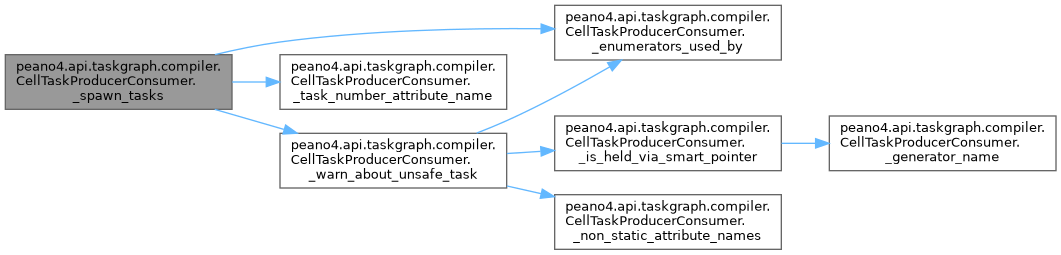
References peano4.api.taskgraph.compiler.CellTaskProducerConsumer._enumerators_used_by(), peano4.api.taskgraph.compiler.CellTaskProducerConsumer._task_number_attribute_name(), and peano4.api.taskgraph.compiler.CellTaskProducerConsumer._warn_about_unsafe_task().
Referenced by peano4.api.taskgraph.compiler.CellTaskProducerConsumer._translate().

|
protected |
Build the producer-consumer graph.
peano4.api.taskgraph.compiler.CellTaskProducerConsumer._translate()
Definition at line 341 of file CellTaskProducerConsumer.py.
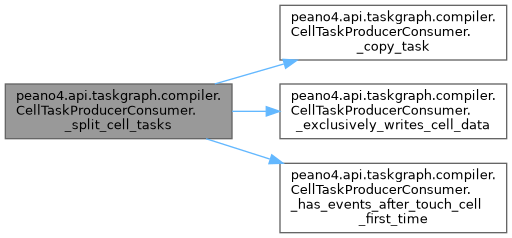
References peano4.api.taskgraph.compiler.CellTaskProducerConsumer._copy_task(), peano4.api.taskgraph.compiler.CellTaskProducerConsumer._exclusively_writes_cell_data(), and peano4.api.taskgraph.compiler.CellTaskProducerConsumer._has_events_after_touch_cell_first_time().
Referenced by peano4.api.taskgraph.compiler.CellTaskProducerConsumer._translate().

|
protected |
CamelCase version of the task's name followed by ActionSet, the action set index and TaskNumber.
Words are separated by whitespace or underscores, and only the first letter of each word is capitalised, so existing camel case and acronyms are preserved. "EulerFVSmooth_Update cell" with action set index 0 for example becomes EulerFVSmoothUpdateCellActionSet0TaskNumber.
Definition at line 259 of file CellTaskProducerConsumer.py.
Referenced by peano4.api.taskgraph.compiler.CellTaskProducerConsumer._spawn_tasks().

|
protected |
Task graph compiler which splits tasks writing cell data into a producer spawning tasks and a consumer waiting for them (work in progress)
Do not use this routine directly. Pick peano4.api.taskgraph.compiler.CellTaskProducerConsumer.translate_with_sequential() or peano4.api.taskgraph.compiler.CellTaskProducerConsumer.translate_with_fusion() instead.
This compiler adds a preamble which rewrites the task graph, and then hands the rewritten graph over to either peano4.api.taskgraph.compiler.Sequential.translate() or peano4.api.taskgraph.compiler.FuseSteps.translate().
Every task which exclusively writes cell data is replaced by two tasks. A task exclusively writes cell data if it declares at least one cell submodel as WRITE or READ_AND_WRITE, but no face or vertex submodel as WRITE or READ_AND_WRITE (peano4.api.taskgraph.compiler.CellTaskProducerConsumer._exclusively_writes_cell_data()). It may read face or vertex data. All other tasks are kept as they are.
A task is only split if this is safe (peano4.api.taskgraph.compiler.CellTaskProducerConsumer._has_events_after_touch_cell_first_time()): The producer spawns tasks which might still run after the producer's mesh traversal. If any action set of the task yields code for unprepareTraversal(), endTraversal() or one of the touch...LastTime() events, these events might be invoked before the spawned tasks have terminated. Such a task is hence not split, and the compiler writes a warning. You can enforce the split by setting the task's flag peano4.api.taskgraph.Task.Task.may_spawn_background_tasks to True, which skips this check. If the flag is False, the task is never split, and the compiler writes no warning.
The two tasks are:
Every task that depended on the original task depends on the consumer instead. Producer and consumer are marked as non-fusable, i.e. if we use FuseSteps, it never puts them into the same mesh traversal. A consumer however might be fused with subsequent tasks. In an ExaHyPE 2 setup, for example, the initial condition yields a producer and a consumer, and the latter is fused with the subsequent projection onto the faces.
The preamble does not alter the graph passed in. It works on a copy of the graph's tasks.
If a peano_project is given, the producer spawns the touchCellFirstTime() events of its action sets as tasks, and the consumer waits for these tasks (peano4.api.taskgraph.compiler.CellTaskProducerConsumer._spawn_tasks()):
The spawned tasks outlive touchCellFirstTime(). The compiler therefore warns about constructs which might not be safe within a task. It does not inspect the code but only searches the generated C++ text for the names of data and attributes, i.e. the warnings state that a task might access something. Every warning names the generator which realises the data in question and suggests a fix. It has to be accepted or the generation is aborted (peano4.api.Logger.Logger.warn_and_confirm()):
The compiler adds a new cell data type <identifier>_TaskLabels to the project's data model. It is modelled via DaStGen2 and holds one integer per producer action set with a non-empty touchCellFirstTime(). The integer's name is the CamelCase version of the original task's name followed by ActionSet, the action set's index within the task and TaskNumber, e.g. EulerFVSmoothInitialConditionActionSet0TaskNumber (peano4.api.taskgraph.compiler.CellTaskProducerConsumer._task_number_attribute_name()). The labels furthermore hold a static tarch::multicore::TaskEnumerator (getTaskEnumerator()), from which the producers take their task numbers and to which the consumers return them. The producer declares the task labels as WRITE, the consumer as READ_AND_DISCARD: The producer sets the label in every sweep, whether it spawns a task or not, so the consumer's reset does not have to be kept. If the consumer declared READ_AND_WRITE, a fused producer step that directly follows a consumer would read the labels, too (peano4.api.taskgraph.compiler.PropagateUseStatements), and the labels would be relayed through steps of other phases which run before the labels are ever stored.
| graph | peano4.api.taskgraph.Graph The task graph to compile. Assumed to be acyclic. |
| identifier | str peano4.api.taskgraph.compiler.FuseSteps.translate() |
| peano_project | peano4.api.Project Project the task labels are added to. If None, no task labels are added and the producers spawn no tasks. |
| use_fusion | bool If True, hand the rewritten graph over to FuseSteps, otherwise to Sequential. |
Definition at line 70 of file CellTaskProducerConsumer.py.
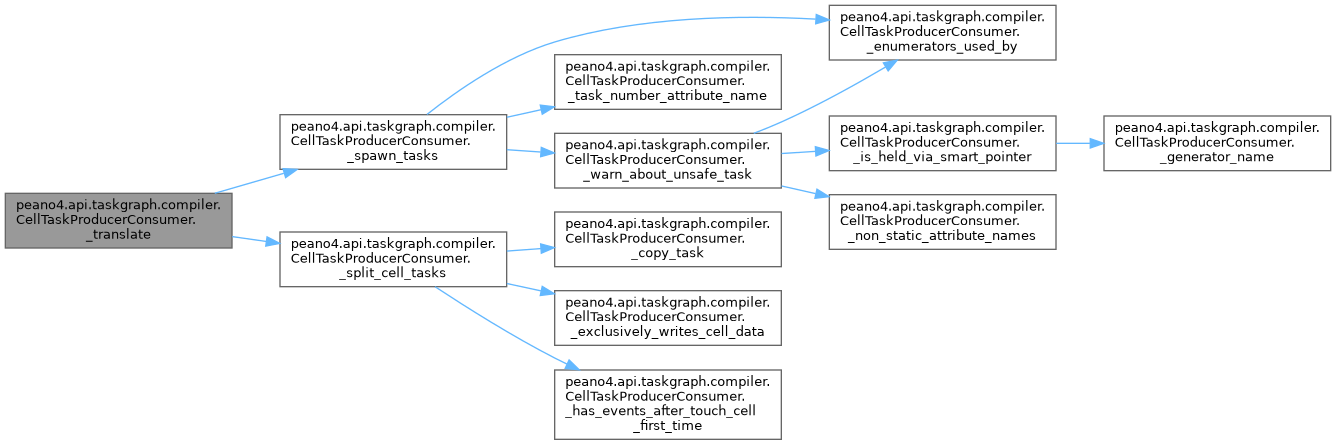
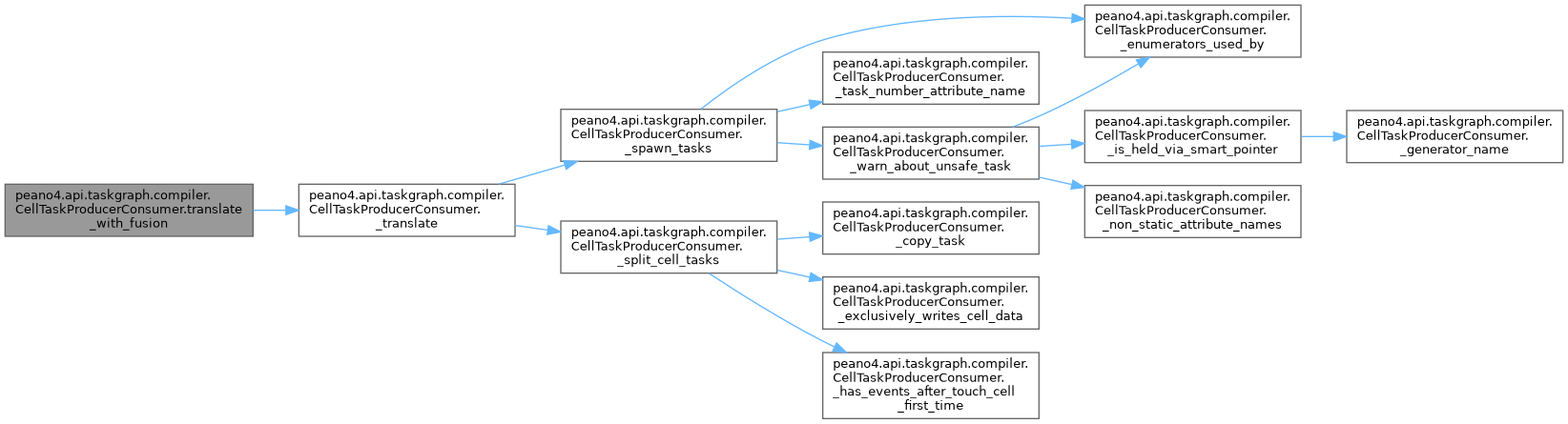
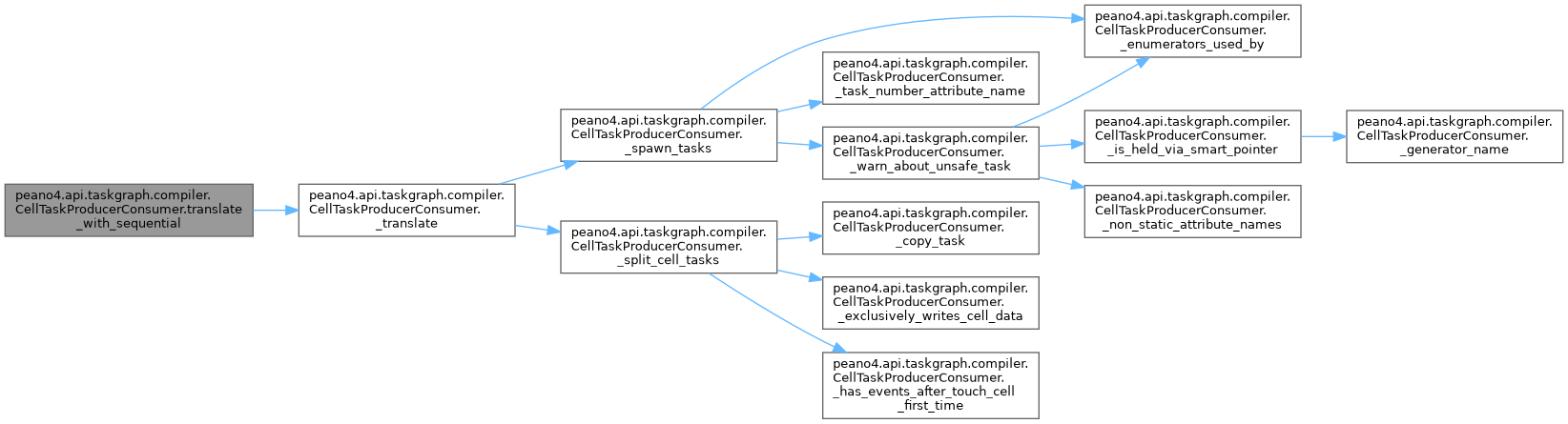
References peano4.api.taskgraph.compiler.CellTaskProducerConsumer._spawn_tasks(), and peano4.api.taskgraph.compiler.CellTaskProducerConsumer._split_cell_tasks().
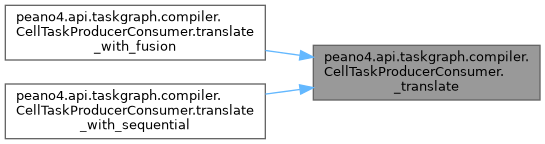
Referenced by peano4.api.taskgraph.compiler.CellTaskProducerConsumer.translate_with_fusion(), and peano4.api.taskgraph.compiler.CellTaskProducerConsumer.translate_with_sequential().
|
protected |
Issue the warnings about task bodies which might not be safe.
peano4.api.taskgraph.compiler.CellTaskProducerConsumer._translate()
We do not inspect the code. We only search the generated C++ text for the names of data and attributes, i.e. the warnings say that a task might access something.
Definition at line 470 of file CellTaskProducerConsumer.py.
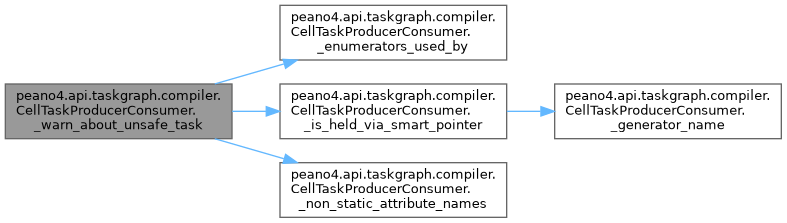
References peano4.api.taskgraph.compiler.CellTaskProducerConsumer._enumerators_used_by(), peano4.api.taskgraph.compiler.CellTaskProducerConsumer._is_held_via_smart_pointer(), and peano4.api.taskgraph.compiler.CellTaskProducerConsumer._non_static_attribute_names().
Referenced by peano4.api.taskgraph.compiler.CellTaskProducerConsumer._spawn_tasks().

| List["peano4.api.solversteps.Step"] peano4.api.taskgraph.compiler.CellTaskProducerConsumer.translate_with_fusion | ( | Graph | graph, |
| str | identifier, | ||
| "peano4.api.Project" | peano_project | ||
| ) |
Split tasks writing cell data into producer and consumer, and fuse tasks into as few mesh traversals as possible.
You can use this task graph compiler in your ExaHyPE 2 project through
The rewritten graph is handed over to peano4.api.taskgraph.compiler.FuseSteps.translate(), which never fuses a producer with its consumer. See peano4.api.taskgraph.compiler.CellTaskProducerConsumer._translate() for a description of the rewrite and of the parameters.
Definition at line 45 of file CellTaskProducerConsumer.py.
References peano4.api.taskgraph.compiler.CellTaskProducerConsumer._translate().
| List["peano4.api.solversteps.Step"] peano4.api.taskgraph.compiler.CellTaskProducerConsumer.translate_with_sequential | ( | Graph | graph, |
| str | identifier, | ||
| "peano4.api.Project" | peano_project | ||
| ) |
Split tasks writing cell data into producer and consumer, and map each task onto its own mesh traversal.
You can use this task graph compiler in your ExaHyPE 2 project through
The rewritten graph is handed over to peano4.api.taskgraph.compiler.Sequential.translate(). See peano4.api.taskgraph.compiler.CellTaskProducerConsumer._translate() for a description of the rewrite and of the parameters.
Definition at line 21 of file CellTaskProducerConsumer.py.
References peano4.api.taskgraph.compiler.CellTaskProducerConsumer._translate().
|
protected |
Definition at line 434 of file CellTaskProducerConsumer.py.
 1.9.8