 |
Peano
|
|
Peano
|
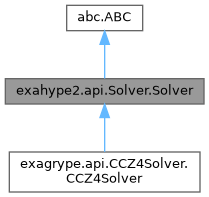
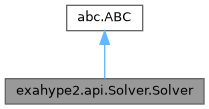
Abstract base class for all ExaHyPE 2 solvers. More...
Data Structures | |
| class | GridConstruction |
| How a Solver drives the construction of the mesh it runs on. More... | |
| class | MeshAdaptation |
| How a Solver adapts its mesh and rebalances its load between two time steps. More... | |
| class | NumericalScheme |
| The concrete discretisation (Finite Volumes, ADER-DG, ...) realised by a Solver. More... | |
| class | Plotter |
| How a Solver writes out its solution. More... | |
| class | SolverGenerator |
| Turns a Solver into actual classes. More... | |
Public Member Functions | |
| __init__ (self, str name, VariableSpecification unknowns, VariableSpecification auxiliary_variables) | |
| Create solver. | |
| str | __str__ (self) |
| str | name (self) |
| Unique solver name. | |
| "Solver.NumericalScheme" | numerical_scheme (self) |
| numerical_scheme (self, "Solver.NumericalScheme" value) | |
| List["Solver.Plotter"] | plotters (self) |
| All plotters of the solver, in the order they have been added. | |
| add_plotter (self, "Solver.Plotter" plotter) | |
| Add a plotter to the solver. | |
| "Solver.Plotter" | plotter (self) |
| Shorthand for solvers with at most one plotter. | |
| plotter (self, "Solver.Plotter" value) | |
| int | unknowns (self) |
| int | auxiliary_variables (self) |
| str | user_solver_includes (self) |
| Add further includes to this property, if your solver requires some additional routines from other header files. | |
| add_user_solver_includes (self, str value) | |
| Add further includes to this property, if your solver requires some additional routines from other header files. | |
| set_solver_constants (self, str datastring) | |
| add_solver_constants (self, str datastring) | |
| List[str] | variable_names_per_entry (self) |
| One name per entry of Q, i.e. | |
| str | get_name_of_global_instance (self) |
| List[PDETerm] | pde_terms (self) |
| All PDE terms (flux, eigenvalues, ...) registered with this solver, in registration order. | |
| bool | requires_user_class (self) |
| True iff at least one PDE term has no implementation. | |
| str | get_name_of_solver_class (self) |
| Name of the C++ class the solver repository instantiates: <SolverName> if requires_user_class, Abstract<SolverName> otherwise. | |
| add_pde_term (self, PDETerm term) | |
| Register a PDE term with this solver, or replace the one already registered under the same name and statelessness. | |
| remove_pde_term (self, str name, bool stateless=False) | |
| Remove a previously registered PDE term by name and statelessness. | |
| PDETerm | get_pde_term (self, str name, bool stateless=False) |
| Look up a previously registered PDE term by name and statelessness. | |
| add_abstract_solver_attribute (self, str declaration) | |
| Add a raw C++ member attribute declaration to the generated Abstract<SolverName> class (. | |
| add_abstract_solver_method (self, str declaration, Callable[[str], str] definition_generator) | |
| Add a raw C++ method to the generated Abstract<SolverName> class: declaration goes into the class body (public section), verbatim. | |
| str | create_readme_descriptor (self, domain_offset, domain_size) |
| Return a human-readable description of this solver instance, to be embedded into the generated project's README. | |
| generate_solver_realisation (self, exahype2_project, peano_project, setup_simulation, time_step, plot, mesh_adaptation) | |
| Turn this solver specification into a task graph and create the required C++ kernels/stubs. | |
Data Fields | |
| solver_generator | |
| pde_terms | |
| True iff at least one PDE term has no implementation. | |
| mesh_adaptation | |
| Turn this solver specification into a task graph and create the required C++ kernels/stubs. | |
Static Public Attributes | |
| str | SolutionUpdateTaskTag = "exahype2.api.Solver.SolutionUpdateTaskTag" |
| Tag of all tasks which write a new solution. | |
| str | IntermediateSolutionUpdateTag = "exahype2.api.Solver.IntermediateSolutionUpdateTag" |
| Tag of all tasks which write an intermediate solution. | |
Protected Member Functions | |
| int | _register_variables (self, VariableSpecification variables, int offset) |
| Translate a plain int or a name-to-multiplicity dict into a total variable count, and - for the dict case - add each name's position within Q to _variable_positions. | |
| str | _get_default_includes (self) |
| Includes every generated action set can rely on being available, regardless of which action sets a concrete discretisation (e.g. | |
| str | _unknown_identifier (self) |
| _add_wants_to_plot_to_solver (self) | |
| Add wantsToPlot() to the solver's C++ class: It holds if any of the solver's plotters is active (exahype2.api.Solver.Solver.Plotter). | |
| _add_checkpoint_meta_data_to_solver (self) | |
| Override exahype2::Solver::toCheckpointMetaData() in the solver's C++ class such that it also writes the attributes added through add_abstract_solver_attribute(), e.g. | |
Protected Attributes | |
| _name | |
| Create solver. | |
| _unknowns | |
| _auxiliary_variables | |
| _user_solver_includes | |
| _solver_constants | |
| _numerical_scheme | |
| _plotters | |
| All plotters of the solver, in the order they have been added. | |
Abstract base class for all ExaHyPE 2 solvers.
Every discretisation ExaHyPE 2 ships (Finite Volumes, ADER-DG, Runge-Kutta Discontinuous Galerkin, Runge-Kutta Finite Differences, ...) is, from the project's point of view, a black box that has to answer a small set of questions: what data does it need on the mesh, which action sets realise its algorithmic steps, and how does it plug into the code generation. This class holds exactly that common contract plus the bits of bookkeeping (name, includes, solver constants, the unknowns/auxiliary_variables variable-shortcut logic) that every concrete solver has historically reimplemented identically. It does not know anything about a concrete discretisation - it neither creates the actual mesh data structures nor the actual action sets, as this remains solver-specific and thus has to be added by all subclasses.
A concrete solver typically extends the constructor with its own discretisation-specific parameters (patch size, polynomial order, time stepping scheme, ...), calls Solver.__init__() for the shared part, and then implements the abstract methods below.
| exahype2.api.Solver.Solver.__init__ | ( | self, | |
| str | name, | ||
| VariableSpecification | unknowns, | ||
| VariableSpecification | auxiliary_variables | ||
| ) |
Create solver.
name: str A unique name for the solver. This one is used for all generated classes. The generated C++ object instance also incorporates this name.
unknowns: int or dict Number of unknowns per mesh entry (Finite Volume voxel, DG degree of freedom, ...). Eventually, unknowns and auxiliary_variables are merged into one big vector, but the solver still has to be able to distinguish them, as only the unknowns are subject to the actual PDE formulation. Can be specified either as a plain int, or as a dict mapping variable name onto multiplicity (e.g. {"rho": 1, "j": 3} for a scalar density plus a 3d momentum). If dicts are used, the generated Abstract<SolverName> class hosts a nested struct Variables with one constant per name, so user code can write Q[Variables::j+1] instead of having to remember the offset into the unknowns array by hand.
auxiliary_variables: int or dict Same semantics as unknowns, but for variables that may be space-dependent yet do not change over time. Their names follow the unknowns' names, as the auxiliary variables follow the unknowns in Q.
If names are used at all, they have to cover all unknowns and all auxiliary variables, i.e. you cannot pass a dict for one and a non-zero int for the other.
The variables cannot be changed after construction: the numerical scheme sizes its data structures from them as soon as it is assigned to the solver.
Reimplemented in exagrype.api.CCZ4Solver.CCZ4Solver.
| str exahype2.api.Solver.Solver.__str__ | ( | self | ) |
Definition at line 531 of file Solver.py.
References peano4.api.output.ActionSet.ActionSet.__class__, peano4.api.output.Jinja2TemplatedHeaderImplementationFilePair.Jinja2TemplatedHeaderImplementationFilePair.__class__, peano4.api.output.TemplatedHeaderFile.TemplatedHeaderFile.__class__, ccz4.CCZ4Solver._auxiliary_variables, SSInfall.SSInfallSolver._auxiliary_variables, solvers.aderdg.ADERDG.ADERDG._auxiliary_variables, solvers.fv.FV.FV._auxiliary_variables, solvers.fv.rusanov.GlobalAdaptiveTimeStep.GlobalAdaptiveTimeStep._auxiliary_variables, solvers.fv.rusanov.GlobalAdaptiveTimeStepWithEnclaveTasking.GlobalAdaptiveTimeStepWithEnclaveTasking._auxiliary_variables, solvers.fv.rusanov.GlobalFixedTimeStep.GlobalFixedTimeStep._auxiliary_variables, solvers.fv.rusanov.GlobalFixedTimeStepWithEnclaveTasking.GlobalFixedTimeStepWithEnclaveTasking._auxiliary_variables, solvers.fv.rusanov.LocalTimeStepWithEnclaveTasking.LocalTimeStepWithEnclaveTasking._auxiliary_variables, solvers.fv.rusanov.SubcyclingAdaptiveTimeStepWithEnclaveTasking.SubcyclingAdaptiveTimeStepWithEnclaveTasking._auxiliary_variables, solvers.fv.rusanov.SubcyclingFixedTimeStep.SubcyclingFixedTimeStep._auxiliary_variables, solvers.fv.rusanov.SubcyclingFixedTimeStepWithEnclaveTasking.SubcyclingFixedTimeStepWithEnclaveTasking._auxiliary_variables, solvers.rkdg.RungeKuttaDG.RungeKuttaDG._auxiliary_variables, solvers.rkdg.rusanov.GlobalAdaptiveTimeStep.GlobalAdaptiveTimeStep._auxiliary_variables, solvers.rkdg.rusanov.GlobalAdaptiveTimeStepWithEnclaveTasking.GlobalAdaptiveTimeStepWithEnclaveTasking._auxiliary_variables, exahype2.api.Solver.Solver._auxiliary_variables, solvers.aderdg.ADERDG.ADERDG._name, solvers.elliptic.AMRMarker.AMRMarker._name, solvers.elliptic.ConstrainedPoissonEquationForMarkerOnCells.ConstrainedPoissonEquationForMarkerOnCells._name, solvers.fv.EnclaveTasking.EnclaveTasking._name, solvers.fv.FV.FV._name, solvers.limiting.PosterioriLimiting.PosterioriLimiting._name, solvers.limiting.StaticLimiting.StaticLimiting._name, solvers.rkdg.RungeKuttaDG.RungeKuttaDG._name, solvers.rkdg.SeparateSweeps.SeparateSweeps._name, solvers.rkdg.SeparateSweepsWithEnclaveTasking.SeparateSweepsWithEnclaveTasking._name, dastgen2.attributes.Attribute.Attribute._name, dastgen2.attributes.BooleanArray.BooleanArray._name, dastgen2.attributes.Enumeration.Enumeration._name, exahype2.api.dslhype.SyntaxTree.MemoryAllocation._name, exahype2.api.dslhype.SyntaxTree.MemoryDeallocation._name, exahype2.api.dslhype.SyntaxTree.Construction._name, exahype2.api.dslhype.SyntaxTree.DataBlockConstructionFromExisting._name, exahype2.api.dslhype.SyntaxTree.DataBlockConstructionFromOperation._name, exahype2.api.dslhype.SyntaxTree.DataBlockConstructionFromMatrixVectorProduct._name, exahype2.api.dslhype.SyntaxTree.DataBlockConstructionFromDotProduct._name, exahype2.api.dslhype.SyntaxTree.DataBlockConstructionFromFunction._name, exahype2.api.Solver.Solver._name, solvers.api.Solver.Solver._name, mghype::matrixfree::solvers::Solver._name, api.solvers.Solver.Solver._name, peano4.api.dastgen2.Peano4DoubleArray.Peano4DoubleArray._name, peano4.api.dastgen2.Peano4IntegerArray.Peano4IntegerArray._name, peano4.api.dastgen2.Peano4SmartPointerDoubleArray.Peano4SmartPointerDoubleArray._name, peano4::RunMultipleSteps._name, tarch::services::ServiceRepository::ServiceEntry._name, api.Tree.Tree._name, solvers.aderdg.ADERDG.ADERDG._unknowns, solvers.fv.FV.FV._unknowns, solvers.fv.rusanov.GlobalAdaptiveTimeStep.GlobalAdaptiveTimeStep._unknowns, solvers.fv.rusanov.GlobalAdaptiveTimeStepWithEnclaveTasking.GlobalAdaptiveTimeStepWithEnclaveTasking._unknowns, solvers.fv.rusanov.GlobalFixedTimeStep.GlobalFixedTimeStep._unknowns, solvers.fv.rusanov.GlobalFixedTimeStepWithEnclaveTasking.GlobalFixedTimeStepWithEnclaveTasking._unknowns, solvers.fv.rusanov.LocalTimeStepWithEnclaveTasking.LocalTimeStepWithEnclaveTasking._unknowns, solvers.fv.rusanov.SubcyclingAdaptiveTimeStepWithEnclaveTasking.SubcyclingAdaptiveTimeStepWithEnclaveTasking._unknowns, solvers.fv.rusanov.SubcyclingFixedTimeStep.SubcyclingFixedTimeStep._unknowns, solvers.fv.rusanov.SubcyclingFixedTimeStepWithEnclaveTasking.SubcyclingFixedTimeStepWithEnclaveTasking._unknowns, solvers.rkdg.RungeKuttaDG.RungeKuttaDG._unknowns, solvers.rkdg.rusanov.GlobalAdaptiveTimeStep.GlobalAdaptiveTimeStep._unknowns, solvers.rkdg.rusanov.GlobalAdaptiveTimeStepWithEnclaveTasking.GlobalAdaptiveTimeStepWithEnclaveTasking._unknowns, exahype2.api.Solver.Solver._unknowns, exahype2::CellAccess._unknowns, exahype2::enumerator::AoSLexicographicEnumerator._unknowns, exahype2::enumerator::AoSoALexicographicEnumerator._unknowns, exahype2::enumerator::FaceAoSLexicographicEnumerator._unknowns, exahype2::enumerator::SingleDoFEnumerator._unknowns, exahype2::enumerator::SoALexicographicEnumerator._unknowns, api.solvers.CollocatedLowOrderDiscretisation.CollocatedLowOrderDiscretisation._unknowns, and tarch.plotter.api.output.Visualiser.PatchFileData._unknowns.
Referenced by peano4.api.toolbox.particles.postprocessing.ParticleVTUReader.VTUParticleSet.__repr__().

|
protected |
Override exahype2::Solver::toCheckpointMetaData() in the solver's C++ class such that it also writes the attributes added through add_abstract_solver_attribute(), e.g.
the time stamps of the next outputs of the plotters. Only attributes of type double, float or int are written, with their name without leading underscore as key.
The counterpart override of exahype2::Solver::fromCheckpointMetaData() restores these attributes. Afterwards, it calls finish<Name>() of all plotters: A plotter which has written output at the time of the checkpoint has done so before it has moved on to its next output, as it only moves on at the end of the plot phase (exahype2.api.Solver.Solver.Plotter). The checkpoint hence holds the time stamp of an output which has already been written. finish<Name>() moves such a plotter on, exactly as the original run has done after the checkpoint, so the restarted simulation does not write this output again.
The overrides evaluate the attributes and plotters the solver has when the C++ code is written, and they are added only once, even if several checkpoints use them or the Peano 4 project is generated multiple times.
Definition at line 867 of file Solver.py.
References exahype2.api.Solver.Solver._plotters, exahype2.api.Solver.Solver.add_abstract_solver_method(), and ScenarioFactory.createScenario().

|
protected |
Add wantsToPlot() to the solver's C++ class: It holds if any of the solver's plotters is active (exahype2.api.Solver.Solver.Plotter).
Solvers without plotters do not get the method, as nobody asks them. The method is added only once, even if the Peano 4 project is generated multiple times, and it evaluates the plotters the solver has when the C++ code is written.
Definition at line 840 of file Solver.py.
References exahype2.api.Solver.Solver._plotters, exahype2.api.Solver.Solver.add_abstract_solver_method(), and ScenarioFactory.createScenario().

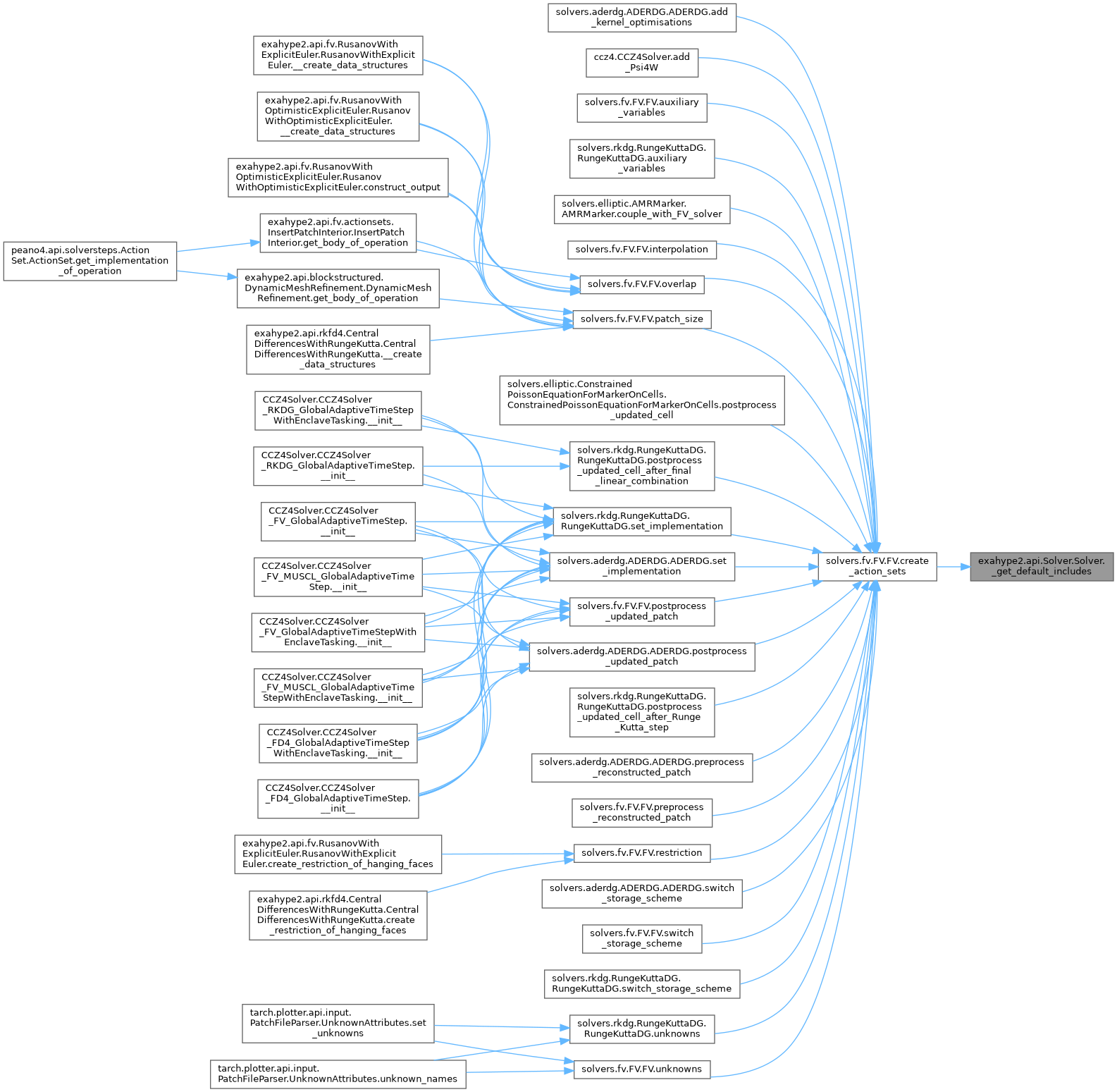
|
protected |
Includes every generated action set can rely on being available, regardless of which action sets a concrete discretisation (e.g.
exahype2.api.fv) actually attaches -
Definition at line 659 of file Solver.py.
Referenced by solvers.fv.FV.FV.create_action_sets().
|
protected |
Translate a plain int or a name-to-multiplicity dict into a total variable count, and - for the dict case - add each name's position within Q to _variable_positions.
Called once for unknowns (offset 0) and once for auxiliary_variables (offset = number of unknowns), so the two end up in one contiguous name/offset table.
Definition at line 503 of file Solver.py.
References ScenarioFactory.createScenario().

|
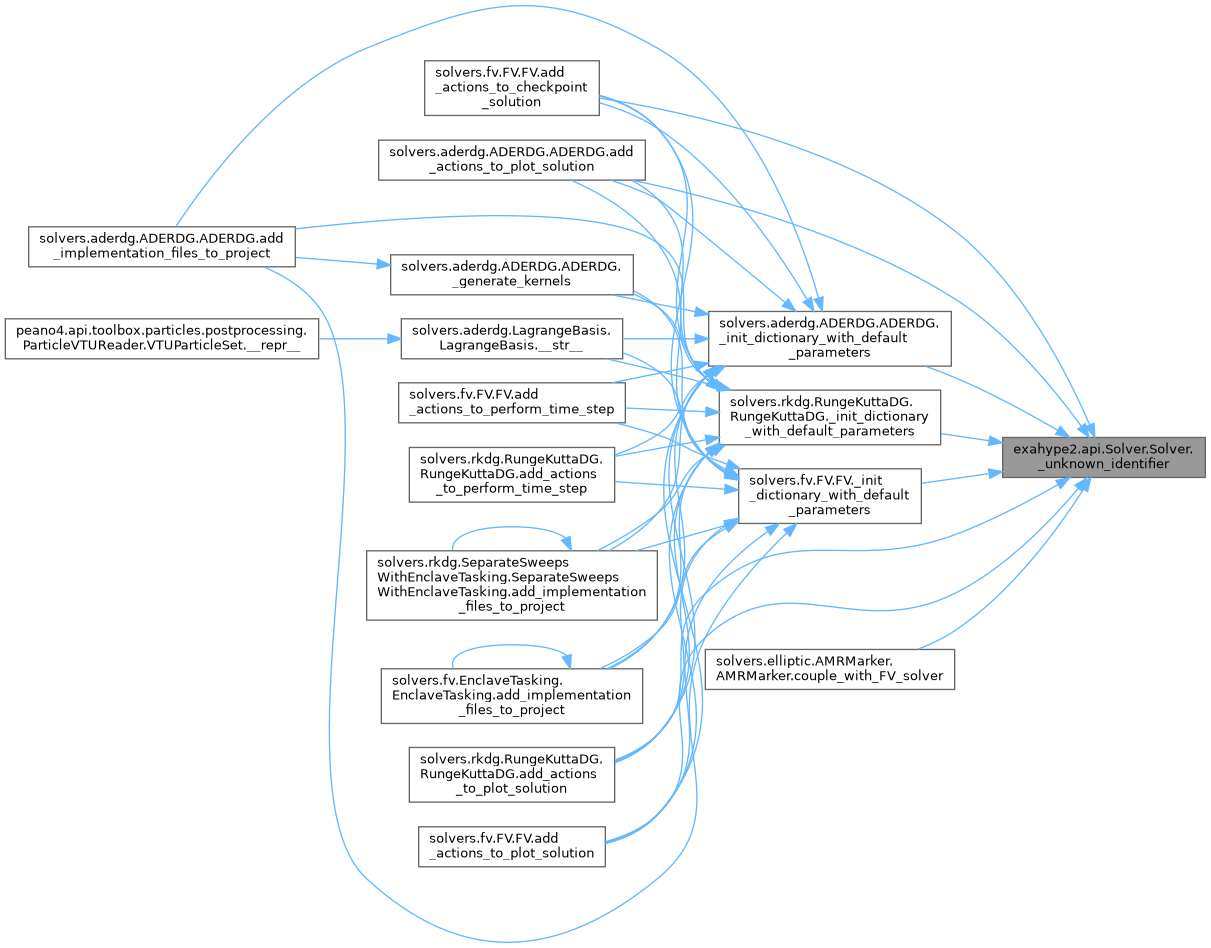
protected |
Definition at line 681 of file Solver.py.
References solvers.aderdg.ADERDG.ADERDG._name, solvers.elliptic.AMRMarker.AMRMarker._name, solvers.elliptic.ConstrainedPoissonEquationForMarkerOnCells.ConstrainedPoissonEquationForMarkerOnCells._name, solvers.fv.EnclaveTasking.EnclaveTasking._name, solvers.fv.FV.FV._name, solvers.limiting.PosterioriLimiting.PosterioriLimiting._name, solvers.limiting.StaticLimiting.StaticLimiting._name, solvers.rkdg.RungeKuttaDG.RungeKuttaDG._name, solvers.rkdg.SeparateSweeps.SeparateSweeps._name, solvers.rkdg.SeparateSweepsWithEnclaveTasking.SeparateSweepsWithEnclaveTasking._name, dastgen2.attributes.Attribute.Attribute._name, dastgen2.attributes.BooleanArray.BooleanArray._name, dastgen2.attributes.Enumeration.Enumeration._name, exahype2.api.dslhype.SyntaxTree.MemoryAllocation._name, exahype2.api.dslhype.SyntaxTree.MemoryDeallocation._name, exahype2.api.dslhype.SyntaxTree.Construction._name, exahype2.api.dslhype.SyntaxTree.DataBlockConstructionFromExisting._name, exahype2.api.dslhype.SyntaxTree.DataBlockConstructionFromOperation._name, exahype2.api.dslhype.SyntaxTree.DataBlockConstructionFromMatrixVectorProduct._name, exahype2.api.dslhype.SyntaxTree.DataBlockConstructionFromDotProduct._name, exahype2.api.dslhype.SyntaxTree.DataBlockConstructionFromFunction._name, exahype2.api.Solver.Solver._name, solvers.api.Solver.Solver._name, mghype::matrixfree::solvers::Solver._name, api.solvers.Solver.Solver._name, peano4.api.dastgen2.Peano4DoubleArray.Peano4DoubleArray._name, peano4.api.dastgen2.Peano4IntegerArray.Peano4IntegerArray._name, peano4.api.dastgen2.Peano4SmartPointerDoubleArray.Peano4SmartPointerDoubleArray._name, peano4::RunMultipleSteps._name, tarch::services::ServiceRepository::ServiceEntry._name, and api.Tree.Tree._name.
Referenced by solvers.aderdg.ADERDG.ADERDG._init_dictionary_with_default_parameters(), solvers.fv.FV.FV._init_dictionary_with_default_parameters(), solvers.rkdg.RungeKuttaDG.RungeKuttaDG._init_dictionary_with_default_parameters(), solvers.fv.FV.FV.add_actions_to_checkpoint_solution(), solvers.aderdg.ADERDG.ADERDG.add_actions_to_plot_solution(), solvers.rkdg.RungeKuttaDG.RungeKuttaDG.add_actions_to_plot_solution(), solvers.fv.FV.FV.add_actions_to_plot_solution(), and solvers.elliptic.AMRMarker.AMRMarker.couple_with_FV_solver().
| exahype2.api.Solver.Solver.add_abstract_solver_attribute | ( | self, | |
| str | declaration | ||
| ) |
Add a raw C++ member attribute declaration to the generated Abstract<SolverName> class (.
Nothing calls this unconditionally: a plain Solver carries no attributes beyond what PDE terms need. It is up to whichever NumericalScheme/GridConstruction/Plotter a solver uses to call this, if it needs solver-level state of its own that genuinely has no home on exahype2::Solver already - e.g. exahype2.api.fv.RusanovWithExplicitEuler deliberately does not use this for time stamp/time step size bookkeeping, since exahype2::Solver (which every generated Abstract<SolverName> already inherits from) already carries _minTimeStamp/_maxTimeStamp/_minTimeStepSize/_maxTimeStepSize and the updateCell()/startTimeStep()/finishTimeStep() lifecycle to maintain them -
Definition at line 775 of file Solver.py.
References ScenarioFactory.createScenario().
Referenced by exahype2.api.Solver.Solver.Plotter._add_time_interval_bookkeeping_to_solver().


| exahype2.api.Solver.Solver.add_abstract_solver_method | ( | self, | |
| str | declaration, | ||
| Callable[[str], str] | definition_generator | ||
| ) |
Add a raw C++ method to the generated Abstract<SolverName> class: declaration goes into the class body (public section), verbatim.
definition_generator is called with the class' fully qualified name once it is known (
Definition at line 802 of file Solver.py.
References ScenarioFactory.createScenario().
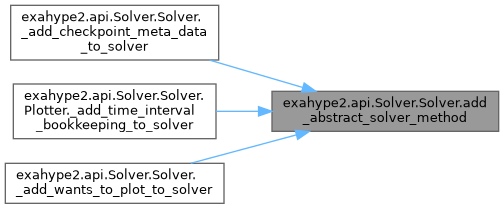
Referenced by exahype2.api.Solver.Solver._add_checkpoint_meta_data_to_solver(), exahype2.api.Solver.Solver.Plotter._add_time_interval_bookkeeping_to_solver(), and exahype2.api.Solver.Solver._add_wants_to_plot_to_solver().

| exahype2.api.Solver.Solver.add_pde_term | ( | self, | |
| PDETerm | term | ||
| ) |
Register a PDE term with this solver, or replace the one already registered under the same name and statelessness.
A solver aggregates an arbitrary number of terms - the well-known ones (Flux(), MaxEigenvalue(), ...) as well as new, solver-specific ones users construct themselves via PDETerm(name=..., implementation=...).
Each term generates exactly one C++ method: the static, GPU-offloadable overload if term.stateless, otherwise the virtual instance method (
Definition at line 744 of file Solver.py.
References ScenarioFactory.createScenario().

| exahype2.api.Solver.Solver.add_plotter | ( | self, | |
| "Solver.Plotter" | plotter | ||
| ) |
Add a plotter to the solver.
A solver can have an arbitrary number of plotters, which are independent of each other (exahype2.api.Solver.Solver.Plotter). If the plotter has no name yet, it gets the name of its class, followed by a number if the solver has another plotter of that name already.
| plotter | exahype2.api.Solver.Plotter The plotter. Its solver has to be this solver. |
Definition at line 566 of file Solver.py.
References exahype2.api.Solver.Solver._plotters.
Referenced by exahype2.api.Solver.Solver.plotter().

| exahype2.api.Solver.Solver.add_solver_constants | ( | self, | |
| str | datastring | ||
| ) |
Definition at line 678 of file Solver.py.
References solvers.aderdg.ADERDG.ADERDG._solver_constants, solvers.fv.FV.FV._solver_constants, solvers.rkdg.RungeKuttaDG.RungeKuttaDG._solver_constants, and exahype2.api.Solver.Solver._solver_constants.
Referenced by CCZ4Solver.AbstractCCZ4Solver.add_all_solver_constants().

| exahype2.api.Solver.Solver.add_user_solver_includes | ( | self, | |
| str | value | ||
| ) |
Add further includes to this property, if your solver requires some additional routines from other header files.
Definition at line 652 of file Solver.py.
References solvers.fv.FV.FV._user_solver_includes, solvers.rkdg.RungeKuttaDG.RungeKuttaDG._user_solver_includes, and exahype2.api.Solver.Solver._user_solver_includes.
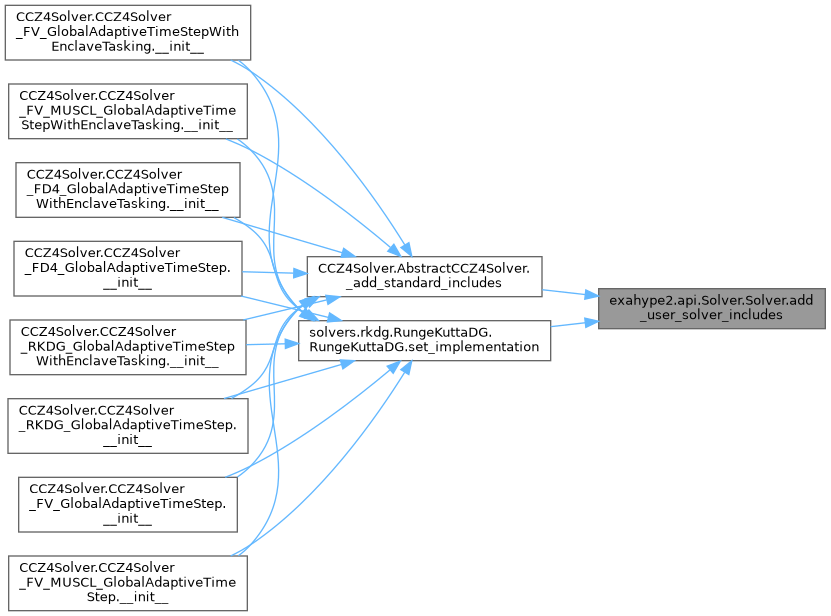
Referenced by CCZ4Solver.AbstractCCZ4Solver._add_standard_includes(), and solvers.rkdg.RungeKuttaDG.RungeKuttaDG.set_implementation().
| int exahype2.api.Solver.Solver.auxiliary_variables | ( | self | ) |
Definition at line 641 of file Solver.py.
References ccz4.CCZ4Solver._auxiliary_variables, SSInfall.SSInfallSolver._auxiliary_variables, solvers.aderdg.ADERDG.ADERDG._auxiliary_variables, solvers.fv.FV.FV._auxiliary_variables, solvers.fv.rusanov.GlobalAdaptiveTimeStep.GlobalAdaptiveTimeStep._auxiliary_variables, solvers.fv.rusanov.GlobalAdaptiveTimeStepWithEnclaveTasking.GlobalAdaptiveTimeStepWithEnclaveTasking._auxiliary_variables, solvers.fv.rusanov.GlobalFixedTimeStep.GlobalFixedTimeStep._auxiliary_variables, solvers.fv.rusanov.GlobalFixedTimeStepWithEnclaveTasking.GlobalFixedTimeStepWithEnclaveTasking._auxiliary_variables, solvers.fv.rusanov.LocalTimeStepWithEnclaveTasking.LocalTimeStepWithEnclaveTasking._auxiliary_variables, solvers.fv.rusanov.SubcyclingAdaptiveTimeStepWithEnclaveTasking.SubcyclingAdaptiveTimeStepWithEnclaveTasking._auxiliary_variables, solvers.fv.rusanov.SubcyclingFixedTimeStep.SubcyclingFixedTimeStep._auxiliary_variables, solvers.fv.rusanov.SubcyclingFixedTimeStepWithEnclaveTasking.SubcyclingFixedTimeStepWithEnclaveTasking._auxiliary_variables, solvers.rkdg.RungeKuttaDG.RungeKuttaDG._auxiliary_variables, solvers.rkdg.rusanov.GlobalAdaptiveTimeStep.GlobalAdaptiveTimeStep._auxiliary_variables, solvers.rkdg.rusanov.GlobalAdaptiveTimeStepWithEnclaveTasking.GlobalAdaptiveTimeStepWithEnclaveTasking._auxiliary_variables, and exahype2.api.Solver.Solver._auxiliary_variables.
| str exahype2.api.Solver.Solver.create_readme_descriptor | ( | self, | |
| domain_offset, | |||
| domain_size | |||
| ) |
| exahype2.api.Solver.Solver.generate_solver_realisation | ( | self, | |
| exahype2_project, | |||
| peano_project, | |||
| setup_simulation, | |||
| time_step, | |||
| plot, | |||
| mesh_adaptation | |||
| ) |
Turn this solver specification into a task graph and create the required C++ kernels/stubs.
peano_project: peano4.api.Project The Peano 4 project that exahype2_project.generate_Peano4_project() is currently assembling. It is a local variable there, not an attribute - merely passed through here, so this solver can add its own artefacts to it.
setup_simulation, time_step, plot, mesh_adaptation: peano4.api.taskgraph.Graph The task graphs of the four algorithmic phases of the surrounding exahype2_project. They are owned by exahype2_project.generate_Peano4_project() and merely passed through here, so this solver can add its own tasks into them.
Reimplemented in exagrype.api.CCZ4Solver.CCZ4Solver.
| str exahype2.api.Solver.Solver.get_name_of_global_instance | ( | self | ) |
Definition at line 710 of file Solver.py.
References solvers.aderdg.ADERDG.ADERDG._name, solvers.elliptic.AMRMarker.AMRMarker._name, solvers.elliptic.ConstrainedPoissonEquationForMarkerOnCells.ConstrainedPoissonEquationForMarkerOnCells._name, solvers.fv.EnclaveTasking.EnclaveTasking._name, solvers.fv.FV.FV._name, solvers.limiting.PosterioriLimiting.PosterioriLimiting._name, solvers.limiting.StaticLimiting.StaticLimiting._name, solvers.rkdg.RungeKuttaDG.RungeKuttaDG._name, solvers.rkdg.SeparateSweeps.SeparateSweeps._name, solvers.rkdg.SeparateSweepsWithEnclaveTasking.SeparateSweepsWithEnclaveTasking._name, dastgen2.attributes.Attribute.Attribute._name, dastgen2.attributes.BooleanArray.BooleanArray._name, dastgen2.attributes.Enumeration.Enumeration._name, exahype2.api.dslhype.SyntaxTree.MemoryAllocation._name, exahype2.api.dslhype.SyntaxTree.MemoryDeallocation._name, exahype2.api.dslhype.SyntaxTree.Construction._name, exahype2.api.dslhype.SyntaxTree.DataBlockConstructionFromExisting._name, exahype2.api.dslhype.SyntaxTree.DataBlockConstructionFromOperation._name, exahype2.api.dslhype.SyntaxTree.DataBlockConstructionFromMatrixVectorProduct._name, exahype2.api.dslhype.SyntaxTree.DataBlockConstructionFromDotProduct._name, exahype2.api.dslhype.SyntaxTree.DataBlockConstructionFromFunction._name, exahype2.api.Solver.Solver._name, solvers.api.Solver.Solver._name, mghype::matrixfree::solvers::Solver._name, api.solvers.Solver.Solver._name, peano4.api.dastgen2.Peano4DoubleArray.Peano4DoubleArray._name, peano4.api.dastgen2.Peano4IntegerArray.Peano4IntegerArray._name, peano4.api.dastgen2.Peano4SmartPointerDoubleArray.Peano4SmartPointerDoubleArray._name, peano4::RunMultipleSteps._name, tarch::services::ServiceRepository::ServiceEntry._name, and api.Tree.Tree._name.
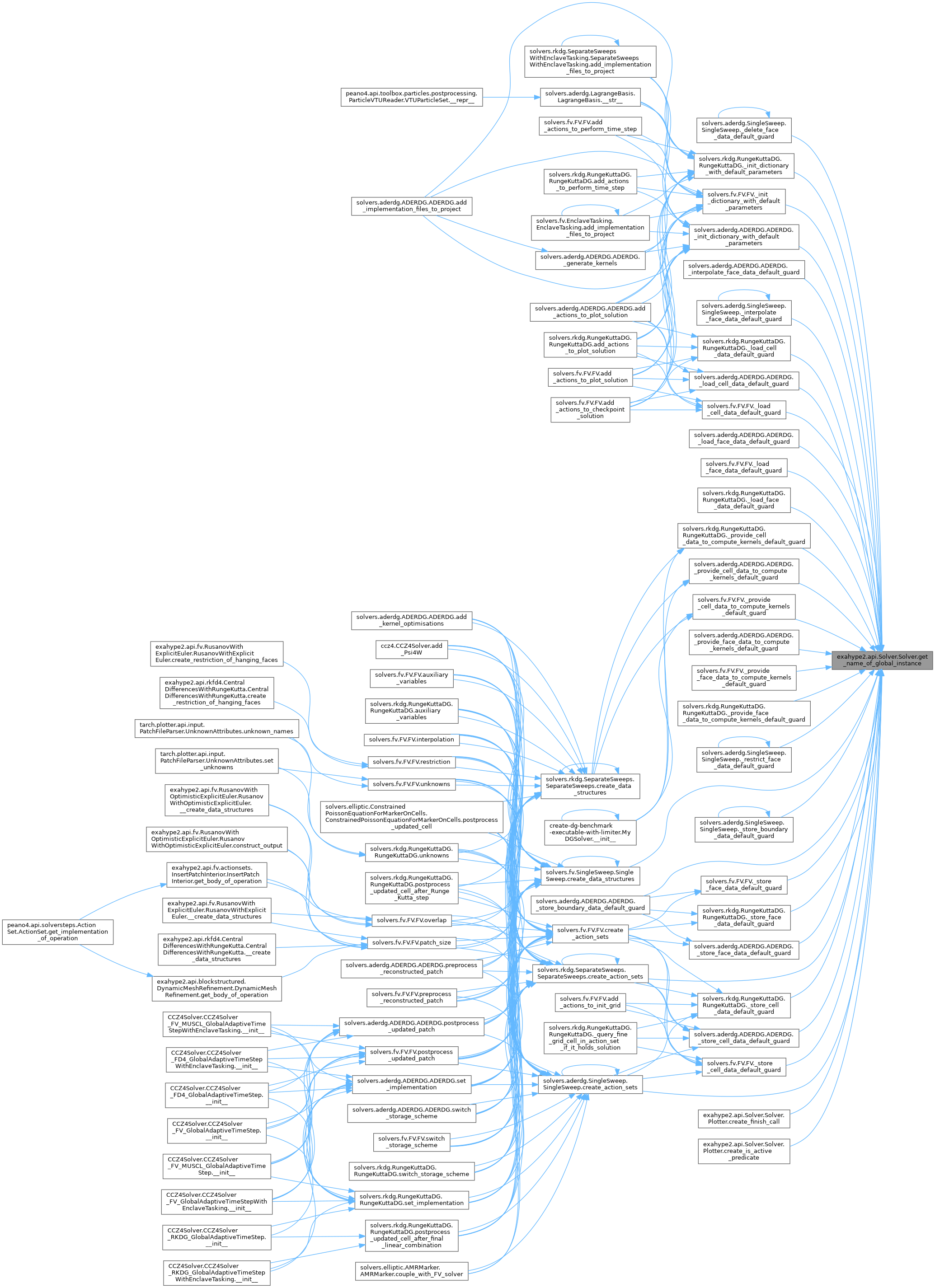
Referenced by solvers.aderdg.SingleSweep.SingleSweep._delete_face_data_default_guard(), solvers.aderdg.ADERDG.ADERDG._init_dictionary_with_default_parameters(), solvers.fv.FV.FV._init_dictionary_with_default_parameters(), solvers.rkdg.RungeKuttaDG.RungeKuttaDG._init_dictionary_with_default_parameters(), solvers.aderdg.ADERDG.ADERDG._interpolate_face_data_default_guard(), solvers.aderdg.SingleSweep.SingleSweep._interpolate_face_data_default_guard(), solvers.aderdg.ADERDG.ADERDG._load_cell_data_default_guard(), solvers.fv.FV.FV._load_cell_data_default_guard(), solvers.rkdg.RungeKuttaDG.RungeKuttaDG._load_cell_data_default_guard(), solvers.aderdg.ADERDG.ADERDG._load_face_data_default_guard(), solvers.fv.FV.FV._load_face_data_default_guard(), solvers.rkdg.RungeKuttaDG.RungeKuttaDG._load_face_data_default_guard(), solvers.aderdg.ADERDG.ADERDG._provide_cell_data_to_compute_kernels_default_guard(), solvers.fv.FV.FV._provide_cell_data_to_compute_kernels_default_guard(), solvers.rkdg.RungeKuttaDG.RungeKuttaDG._provide_cell_data_to_compute_kernels_default_guard(), solvers.aderdg.ADERDG.ADERDG._provide_face_data_to_compute_kernels_default_guard(), solvers.fv.FV.FV._provide_face_data_to_compute_kernels_default_guard(), solvers.rkdg.RungeKuttaDG.RungeKuttaDG._provide_face_data_to_compute_kernels_default_guard(), solvers.aderdg.SingleSweep.SingleSweep._restrict_face_data_default_guard(), solvers.aderdg.ADERDG.ADERDG._store_boundary_data_default_guard(), solvers.aderdg.SingleSweep.SingleSweep._store_boundary_data_default_guard(), solvers.aderdg.ADERDG.ADERDG._store_cell_data_default_guard(), solvers.fv.FV.FV._store_cell_data_default_guard(), solvers.rkdg.RungeKuttaDG.RungeKuttaDG._store_cell_data_default_guard(), solvers.aderdg.ADERDG.ADERDG._store_face_data_default_guard(), solvers.fv.FV.FV._store_face_data_default_guard(), solvers.rkdg.RungeKuttaDG.RungeKuttaDG._store_face_data_default_guard(), solvers.aderdg.SingleSweep.SingleSweep.create_action_sets(), solvers.rkdg.SeparateSweeps.SeparateSweeps.create_action_sets(), solvers.fv.SingleSweep.SingleSweep.create_data_structures(), exahype2.api.Solver.Solver.Plotter.create_finish_call(), and exahype2.api.Solver.Solver.Plotter.create_is_active_predicate().
| str exahype2.api.Solver.Solver.get_name_of_solver_class | ( | self | ) |
Name of the C++ class the solver repository instantiates: <SolverName> if requires_user_class, Abstract<SolverName> otherwise.
Definition at line 737 of file Solver.py.
References solvers.aderdg.ADERDG.ADERDG._name, solvers.elliptic.AMRMarker.AMRMarker._name, solvers.elliptic.ConstrainedPoissonEquationForMarkerOnCells.ConstrainedPoissonEquationForMarkerOnCells._name, solvers.fv.EnclaveTasking.EnclaveTasking._name, solvers.fv.FV.FV._name, solvers.limiting.PosterioriLimiting.PosterioriLimiting._name, solvers.limiting.StaticLimiting.StaticLimiting._name, solvers.rkdg.RungeKuttaDG.RungeKuttaDG._name, solvers.rkdg.SeparateSweeps.SeparateSweeps._name, solvers.rkdg.SeparateSweepsWithEnclaveTasking.SeparateSweepsWithEnclaveTasking._name, dastgen2.attributes.Attribute.Attribute._name, dastgen2.attributes.BooleanArray.BooleanArray._name, dastgen2.attributes.Enumeration.Enumeration._name, exahype2.api.dslhype.SyntaxTree.MemoryAllocation._name, exahype2.api.dslhype.SyntaxTree.MemoryDeallocation._name, exahype2.api.dslhype.SyntaxTree.Construction._name, exahype2.api.dslhype.SyntaxTree.DataBlockConstructionFromExisting._name, exahype2.api.dslhype.SyntaxTree.DataBlockConstructionFromOperation._name, exahype2.api.dslhype.SyntaxTree.DataBlockConstructionFromMatrixVectorProduct._name, exahype2.api.dslhype.SyntaxTree.DataBlockConstructionFromDotProduct._name, exahype2.api.dslhype.SyntaxTree.DataBlockConstructionFromFunction._name, exahype2.api.Solver.Solver._name, solvers.api.Solver.Solver._name, mghype::matrixfree::solvers::Solver._name, api.solvers.Solver.Solver._name, peano4.api.dastgen2.Peano4DoubleArray.Peano4DoubleArray._name, peano4.api.dastgen2.Peano4IntegerArray.Peano4IntegerArray._name, peano4.api.dastgen2.Peano4SmartPointerDoubleArray.Peano4SmartPointerDoubleArray._name, peano4::RunMultipleSteps._name, tarch::services::ServiceRepository::ServiceEntry._name, api.Tree.Tree._name, and exahype2.api.Solver.Solver.requires_user_class().

| PDETerm exahype2.api.Solver.Solver.get_pde_term | ( | self, | |
| str | name, | ||
| bool | stateless = False |
||
| ) |
Look up a previously registered PDE term by name and statelessness.
Definition at line 771 of file Solver.py.
References ScenarioFactory.createScenario().

| str exahype2.api.Solver.Solver.name | ( | self | ) |
Unique solver name.
Feeds into all generated class and instance names.
Definition at line 540 of file Solver.py.
References solvers.aderdg.ADERDG.ADERDG._name, solvers.elliptic.AMRMarker.AMRMarker._name, solvers.elliptic.ConstrainedPoissonEquationForMarkerOnCells.ConstrainedPoissonEquationForMarkerOnCells._name, solvers.fv.EnclaveTasking.EnclaveTasking._name, solvers.fv.FV.FV._name, solvers.limiting.PosterioriLimiting.PosterioriLimiting._name, solvers.limiting.StaticLimiting.StaticLimiting._name, solvers.rkdg.RungeKuttaDG.RungeKuttaDG._name, solvers.rkdg.SeparateSweeps.SeparateSweeps._name, solvers.rkdg.SeparateSweepsWithEnclaveTasking.SeparateSweepsWithEnclaveTasking._name, dastgen2.attributes.Attribute.Attribute._name, dastgen2.attributes.BooleanArray.BooleanArray._name, dastgen2.attributes.Enumeration.Enumeration._name, exahype2.api.dslhype.SyntaxTree.MemoryAllocation._name, exahype2.api.dslhype.SyntaxTree.MemoryDeallocation._name, exahype2.api.dslhype.SyntaxTree.Construction._name, exahype2.api.dslhype.SyntaxTree.DataBlockConstructionFromExisting._name, exahype2.api.dslhype.SyntaxTree.DataBlockConstructionFromOperation._name, exahype2.api.dslhype.SyntaxTree.DataBlockConstructionFromMatrixVectorProduct._name, exahype2.api.dslhype.SyntaxTree.DataBlockConstructionFromDotProduct._name, exahype2.api.dslhype.SyntaxTree.DataBlockConstructionFromFunction._name, exahype2.api.Solver.Solver._name, solvers.api.Solver.Solver._name, mghype::matrixfree::solvers::Solver._name, api.solvers.Solver.Solver._name, peano4.api.dastgen2.Peano4DoubleArray.Peano4DoubleArray._name, peano4.api.dastgen2.Peano4IntegerArray.Peano4IntegerArray._name, peano4.api.dastgen2.Peano4SmartPointerDoubleArray.Peano4SmartPointerDoubleArray._name, peano4::RunMultipleSteps._name, tarch::services::ServiceRepository::ServiceEntry._name, and api.Tree.Tree._name.
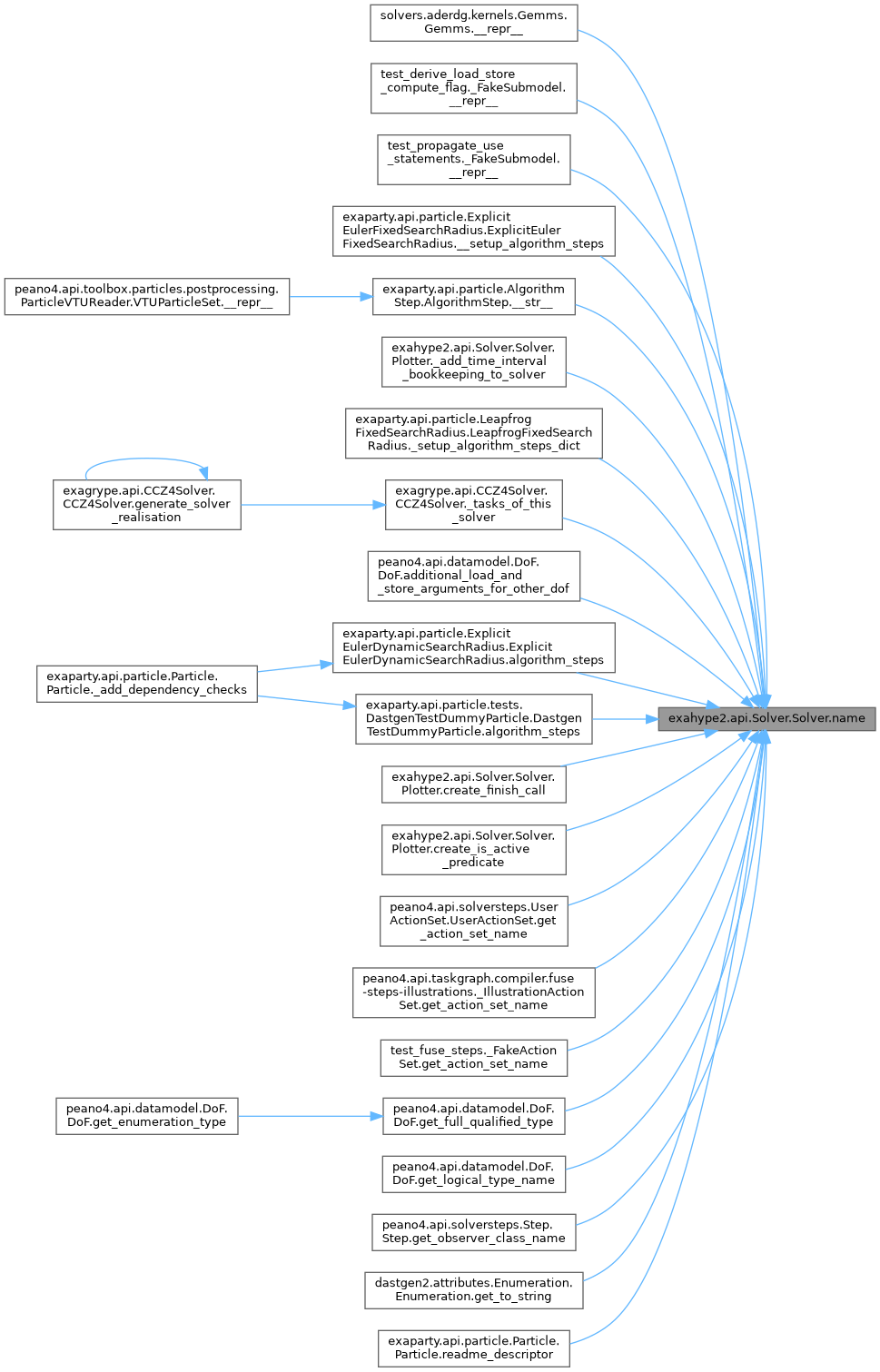
Referenced by solvers.aderdg.kernels.Gemms.Gemms.__repr__(), test_derive_load_store_compute_flag._FakeSubmodel.__repr__(), test_propagate_use_statements._FakeSubmodel.__repr__(), exaparty.api.particle.ExplicitEulerFixedSearchRadius.ExplicitEulerFixedSearchRadius.__setup_algorithm_steps(), exaparty.api.particle.AlgorithmStep.AlgorithmStep.__str__(), exahype2.api.Solver.Solver.Plotter._add_time_interval_bookkeeping_to_solver(), exaparty.api.particle.LeapfrogFixedSearchRadius.LeapfrogFixedSearchRadius._setup_algorithm_steps_dict(), exagrype.api.CCZ4Solver.CCZ4Solver._tasks_of_this_solver(), peano4.api.datamodel.DoF.DoF.additional_load_and_store_arguments_for_other_dof(), exaparty.api.particle.ExplicitEulerDynamicSearchRadius.ExplicitEulerDynamicSearchRadius.algorithm_steps(), exaparty.api.particle.tests.DastgenTestDummyParticle.DastgenTestDummyParticle.algorithm_steps(), exahype2.api.Solver.Solver.Plotter.create_finish_call(), exahype2.api.Solver.Solver.Plotter.create_is_active_predicate(), peano4.api.solversteps.UserActionSet.UserActionSet.get_action_set_name(), peano4.api.taskgraph.compiler.fuse-steps-illustrations._IllustrationActionSet.get_action_set_name(), test_fuse_steps._FakeActionSet.get_action_set_name(), peano4.api.datamodel.DoF.DoF.get_full_qualified_type(), peano4.api.datamodel.DoF.DoF.get_logical_type_name(), peano4.api.solversteps.Step.Step.get_observer_class_name(), dastgen2.attributes.Enumeration.Enumeration.get_to_string(), and exaparty.api.particle.Particle.Particle.readme_descriptor().
| "Solver.NumericalScheme" exahype2.api.Solver.Solver.numerical_scheme | ( | self | ) |
Definition at line 547 of file Solver.py.
References exahype2.api.Solver.Solver._numerical_scheme.
Referenced by exagrype.api.CCZ4Solver.CCZ4Solver.generate_solver_realisation().

| exahype2.api.Solver.Solver.numerical_scheme | ( | self, | |
| "Solver.NumericalScheme" | value | ||
| ) |
Definition at line 551 of file Solver.py.
Referenced by exagrype.api.CCZ4Solver.CCZ4Solver.generate_solver_realisation().

| List[PDETerm] exahype2.api.Solver.Solver.pde_terms | ( | self | ) |
All PDE terms (flux, eigenvalues, ...) registered with this solver, in registration order.
A given name can appear at most twice - once stateless, once not,
Definition at line 714 of file Solver.py.
References ScenarioFactory.createScenario().

| "Solver.Plotter" exahype2.api.Solver.Solver.plotter | ( | self | ) |
Shorthand for solvers with at most one plotter.
Reading it yields the solver's only plotter, or None if it has none. Assigning a plotter replaces all plotters of the solver by this one, assigning None removes all plotters. Use add_plotter() to give a solver more than one plotter.
Definition at line 613 of file Solver.py.
References exahype2.api.Solver.Solver._plotters.
| exahype2.api.Solver.Solver.plotter | ( | self, | |
| "Solver.Plotter" | value | ||
| ) |
Definition at line 631 of file Solver.py.
References exahype2.api.Solver.Solver._plotters, and exahype2.api.Solver.Solver.add_plotter().

| List["Solver.Plotter"] exahype2.api.Solver.Solver.plotters | ( | self | ) |
| exahype2.api.Solver.Solver.remove_pde_term | ( | self, | |
| str | name, | ||
| bool | stateless = False |
||
| ) |
Remove a previously registered PDE term by name and statelessness.
Definition at line 767 of file Solver.py.
References ScenarioFactory.createScenario().

| bool exahype2.api.Solver.Solver.requires_user_class | ( | self | ) |
True iff at least one PDE term has no implementation.
Only then does the user have to provide one, i.e. only then is a <SolverName> class derived from Abstract<SolverName> generated and added to the Makefile (
Definition at line 725 of file Solver.py.
Referenced by exahype2.api.Solver.Solver.get_name_of_solver_class().

| exahype2.api.Solver.Solver.set_solver_constants | ( | self, | |
| str | datastring | ||
| ) |
Definition at line 675 of file Solver.py.
References solvers.aderdg.ADERDG.ADERDG._solver_constants, solvers.fv.FV.FV._solver_constants, solvers.rkdg.RungeKuttaDG.RungeKuttaDG._solver_constants, and exahype2.api.Solver.Solver._solver_constants.
| int exahype2.api.Solver.Solver.unknowns | ( | self | ) |
Definition at line 637 of file Solver.py.
References solvers.aderdg.ADERDG.ADERDG._unknowns, solvers.fv.FV.FV._unknowns, solvers.fv.rusanov.GlobalAdaptiveTimeStep.GlobalAdaptiveTimeStep._unknowns, solvers.fv.rusanov.GlobalAdaptiveTimeStepWithEnclaveTasking.GlobalAdaptiveTimeStepWithEnclaveTasking._unknowns, solvers.fv.rusanov.GlobalFixedTimeStep.GlobalFixedTimeStep._unknowns, solvers.fv.rusanov.GlobalFixedTimeStepWithEnclaveTasking.GlobalFixedTimeStepWithEnclaveTasking._unknowns, solvers.fv.rusanov.LocalTimeStepWithEnclaveTasking.LocalTimeStepWithEnclaveTasking._unknowns, solvers.fv.rusanov.SubcyclingAdaptiveTimeStepWithEnclaveTasking.SubcyclingAdaptiveTimeStepWithEnclaveTasking._unknowns, solvers.fv.rusanov.SubcyclingFixedTimeStep.SubcyclingFixedTimeStep._unknowns, solvers.fv.rusanov.SubcyclingFixedTimeStepWithEnclaveTasking.SubcyclingFixedTimeStepWithEnclaveTasking._unknowns, solvers.rkdg.RungeKuttaDG.RungeKuttaDG._unknowns, solvers.rkdg.rusanov.GlobalAdaptiveTimeStep.GlobalAdaptiveTimeStep._unknowns, solvers.rkdg.rusanov.GlobalAdaptiveTimeStepWithEnclaveTasking.GlobalAdaptiveTimeStepWithEnclaveTasking._unknowns, exahype2.api.Solver.Solver._unknowns, exahype2::CellAccess._unknowns, exahype2::enumerator::AoSLexicographicEnumerator._unknowns, exahype2::enumerator::AoSoALexicographicEnumerator._unknowns, exahype2::enumerator::FaceAoSLexicographicEnumerator._unknowns, exahype2::enumerator::SingleDoFEnumerator._unknowns, exahype2::enumerator::SoALexicographicEnumerator._unknowns, api.solvers.CollocatedLowOrderDiscretisation.CollocatedLowOrderDiscretisation._unknowns, and tarch.plotter.api.output.Visualiser.PatchFileData._unknowns.
Referenced by tarch.plotter.api.input.PatchFileParser.UnknownAttributes.set_unknowns(), and tarch.plotter.api.input.PatchFileParser.UnknownAttributes.unknown_names().

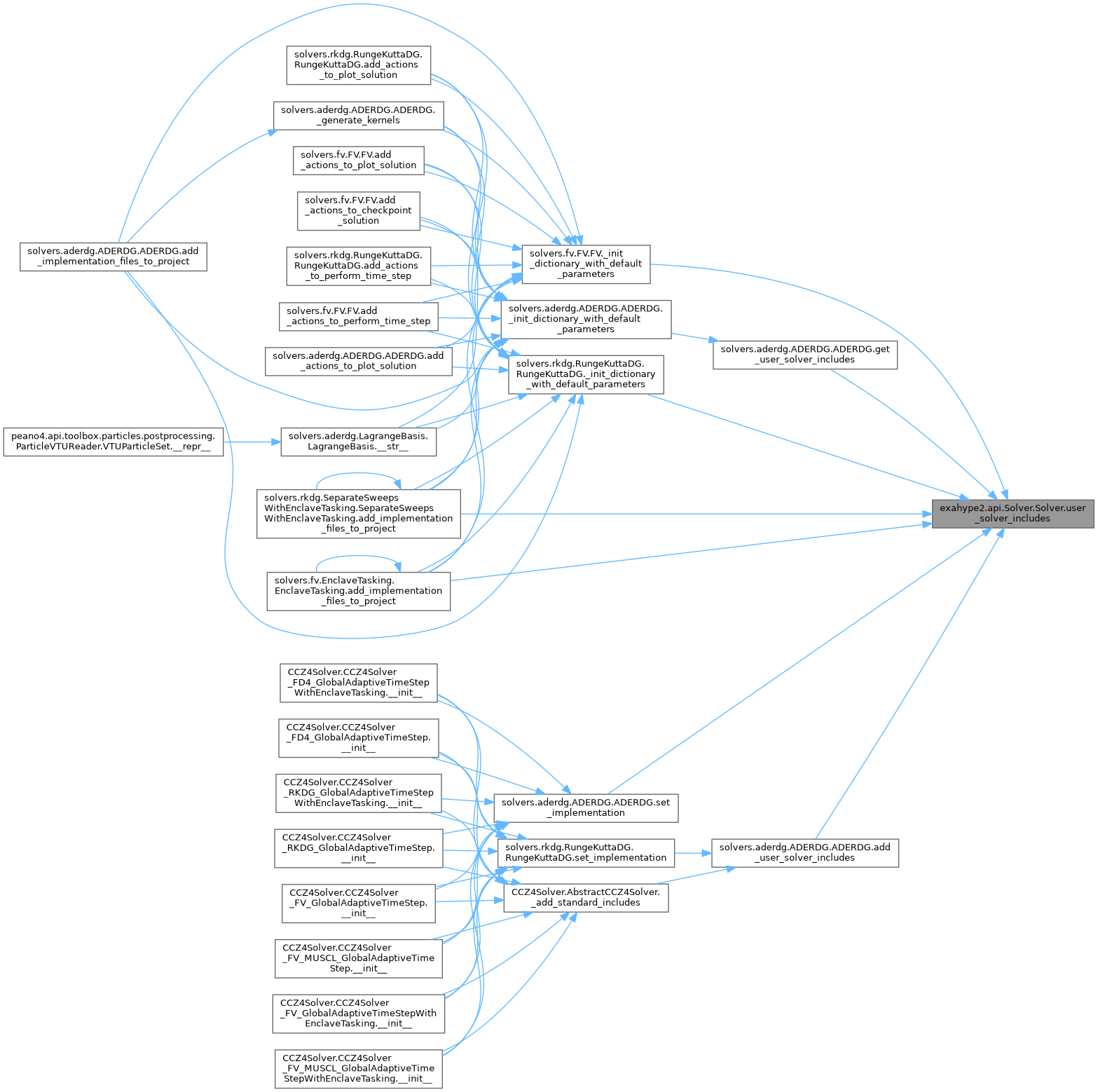
| str exahype2.api.Solver.Solver.user_solver_includes | ( | self | ) |
Add further includes to this property, if your solver requires some additional routines from other header files.
Definition at line 645 of file Solver.py.
References solvers.fv.FV.FV._user_solver_includes, solvers.rkdg.RungeKuttaDG.RungeKuttaDG._user_solver_includes, and exahype2.api.Solver.Solver._user_solver_includes.
Referenced by solvers.fv.FV.FV._init_dictionary_with_default_parameters(), solvers.rkdg.RungeKuttaDG.RungeKuttaDG._init_dictionary_with_default_parameters(), solvers.fv.EnclaveTasking.EnclaveTasking.add_implementation_files_to_project(), solvers.rkdg.SeparateSweepsWithEnclaveTasking.SeparateSweepsWithEnclaveTasking.add_implementation_files_to_project(), solvers.aderdg.ADERDG.ADERDG.add_user_solver_includes(), solvers.aderdg.ADERDG.ADERDG.get_user_solver_includes(), and solvers.aderdg.ADERDG.ADERDG.set_implementation().
| List[str] exahype2.api.Solver.Solver.variable_names_per_entry | ( | self | ) |
One name per entry of Q, i.e.
for the unknowns followed by the auxiliary variables, or the empty list if the variables carry no names. A variable with multiplicity one keeps its name, whereas a variable v with multiplicity k yields the names v[0], ..., v[k-1], i.e. the entries Q[Variables::v+0], ..., Q[Variables::v+k-1]. Plotters use these names to label the entries in their output.
Definition at line 684 of file Solver.py.
References ccz4.CCZ4Solver._auxiliary_variables, SSInfall.SSInfallSolver._auxiliary_variables, solvers.aderdg.ADERDG.ADERDG._auxiliary_variables, solvers.fv.FV.FV._auxiliary_variables, solvers.fv.rusanov.GlobalAdaptiveTimeStep.GlobalAdaptiveTimeStep._auxiliary_variables, solvers.fv.rusanov.GlobalAdaptiveTimeStepWithEnclaveTasking.GlobalAdaptiveTimeStepWithEnclaveTasking._auxiliary_variables, solvers.fv.rusanov.GlobalFixedTimeStep.GlobalFixedTimeStep._auxiliary_variables, solvers.fv.rusanov.GlobalFixedTimeStepWithEnclaveTasking.GlobalFixedTimeStepWithEnclaveTasking._auxiliary_variables, solvers.fv.rusanov.LocalTimeStepWithEnclaveTasking.LocalTimeStepWithEnclaveTasking._auxiliary_variables, solvers.fv.rusanov.SubcyclingAdaptiveTimeStepWithEnclaveTasking.SubcyclingAdaptiveTimeStepWithEnclaveTasking._auxiliary_variables, solvers.fv.rusanov.SubcyclingFixedTimeStep.SubcyclingFixedTimeStep._auxiliary_variables, solvers.fv.rusanov.SubcyclingFixedTimeStepWithEnclaveTasking.SubcyclingFixedTimeStepWithEnclaveTasking._auxiliary_variables, solvers.rkdg.RungeKuttaDG.RungeKuttaDG._auxiliary_variables, solvers.rkdg.rusanov.GlobalAdaptiveTimeStep.GlobalAdaptiveTimeStep._auxiliary_variables, solvers.rkdg.rusanov.GlobalAdaptiveTimeStepWithEnclaveTasking.GlobalAdaptiveTimeStepWithEnclaveTasking._auxiliary_variables, exahype2.api.Solver.Solver._auxiliary_variables, solvers.aderdg.ADERDG.ADERDG._unknowns, solvers.fv.FV.FV._unknowns, solvers.fv.rusanov.GlobalAdaptiveTimeStep.GlobalAdaptiveTimeStep._unknowns, solvers.fv.rusanov.GlobalAdaptiveTimeStepWithEnclaveTasking.GlobalAdaptiveTimeStepWithEnclaveTasking._unknowns, solvers.fv.rusanov.GlobalFixedTimeStep.GlobalFixedTimeStep._unknowns, solvers.fv.rusanov.GlobalFixedTimeStepWithEnclaveTasking.GlobalFixedTimeStepWithEnclaveTasking._unknowns, solvers.fv.rusanov.LocalTimeStepWithEnclaveTasking.LocalTimeStepWithEnclaveTasking._unknowns, solvers.fv.rusanov.SubcyclingAdaptiveTimeStepWithEnclaveTasking.SubcyclingAdaptiveTimeStepWithEnclaveTasking._unknowns, solvers.fv.rusanov.SubcyclingFixedTimeStep.SubcyclingFixedTimeStep._unknowns, solvers.fv.rusanov.SubcyclingFixedTimeStepWithEnclaveTasking.SubcyclingFixedTimeStepWithEnclaveTasking._unknowns, solvers.rkdg.RungeKuttaDG.RungeKuttaDG._unknowns, solvers.rkdg.rusanov.GlobalAdaptiveTimeStep.GlobalAdaptiveTimeStep._unknowns, solvers.rkdg.rusanov.GlobalAdaptiveTimeStepWithEnclaveTasking.GlobalAdaptiveTimeStepWithEnclaveTasking._unknowns, exahype2.api.Solver.Solver._unknowns, exahype2::CellAccess._unknowns, exahype2::enumerator::AoSLexicographicEnumerator._unknowns, exahype2::enumerator::AoSoALexicographicEnumerator._unknowns, exahype2::enumerator::FaceAoSLexicographicEnumerator._unknowns, exahype2::enumerator::SingleDoFEnumerator._unknowns, exahype2::enumerator::SoALexicographicEnumerator._unknowns, api.solvers.CollocatedLowOrderDiscretisation.CollocatedLowOrderDiscretisation._unknowns, tarch.plotter.api.output.Visualiser.PatchFileData._unknowns, and ScenarioFactory.createScenario().

|
protected |
Definition at line 424 of file Solver.py.
Referenced by solvers.rkdg.RungeKuttaDG.RungeKuttaDG.__str__(), exahype2.api.Solver.Solver.__str__(), solvers.aderdg.ADERDG.ADERDG._init_dictionary_with_default_parameters(), solvers.fv.FV.FV._init_dictionary_with_default_parameters(), solvers.rkdg.RungeKuttaDG.RungeKuttaDG._init_dictionary_with_default_parameters(), SSInfall.SSInfallSolver.add_mass_cal_rhointer(), ccz4.CCZ4Solver.add_Psi4W(), solvers.aderdg.ADERDG.ADERDG.auxiliary_variables(), solvers.fv.FV.FV.auxiliary_variables(), solvers.rkdg.RungeKuttaDG.RungeKuttaDG.auxiliary_variables(), exahype2.api.Solver.Solver.auxiliary_variables(), solvers.fv.FV.FV.auxiliary_variables(), solvers.rkdg.RungeKuttaDG.RungeKuttaDG.auxiliary_variables(), and exahype2.api.Solver.Solver.variable_names_per_entry().
|
protected |
Create solver.
Turn this solver specification into a task graph and create the required C++ kernels/stubs.
name: str A unique name for the solver. This one is used for all generated classes. The generated C++ object instance also incorporates this name.
unknowns: int or dict Number of unknowns per mesh entry (Finite Volume voxel, DG degree of freedom, ...). Eventually, unknowns and auxiliary_variables are merged into one big vector, but the solver still has to be able to distinguish them, as only the unknowns are subject to the actual PDE formulation. Can be specified either as a plain int, or as a dict mapping variable name onto multiplicity (e.g. {"rho": 1, "j": 3} for a scalar density plus a 3d momentum). If dicts are used, the generated Abstract<SolverName> class hosts a nested struct Variables with one constant per name, so user code can write Q[Variables::j+1] instead of having to remember the offset into the unknowns array by hand.
auxiliary_variables: int or dict Same semantics as unknowns, but for variables that may be space-dependent yet do not change over time. Their names follow the unknowns' names, as the auxiliary variables follow the unknowns in Q.
If names are used at all, they have to cover all unknowns and all auxiliary variables, i.e. you cannot pass a dict for one and a non-zero int for the other.
The variables cannot be changed after construction: the numerical scheme sizes its data structures from them as soon as it is assigned to the solver.
peano_project: peano4.api.Project The Peano 4 project that exahype2_project.generate_Peano4_project() is currently assembling. It is a local variable there, not an attribute - merely passed through here, so this solver can add its own artefacts to it.
setup_simulation, time_step, plot, mesh_adaptation: peano4.api.taskgraph.Graph The task graphs of the four algorithmic phases of the surrounding exahype2_project. They are owned by exahype2_project.generate_Peano4_project() and merely passed through here, so this solver can add its own tasks into them.
Definition at line 418 of file Solver.py.
Referenced by solvers.aderdg.ADERDG.ADERDG.__str__(), solvers.elliptic.AMRMarker.AMRMarker.__str__(), solvers.elliptic.ConstrainedPoissonEquationForMarkerOnCells.ConstrainedPoissonEquationForMarkerOnCells.__str__(), solvers.fv.FV.FV.__str__(), solvers.rkdg.RungeKuttaDG.RungeKuttaDG.__str__(), exahype2.api.Solver.Solver.__str__(), solvers.api.Solver.Solver.__str__(), api.Tree.Tree.__str__(), solvers.fv.EnclaveTasking.EnclaveTasking._enclave_task_name(), dastgen2.attributes.Enumeration.Enumeration._enum_name(), solvers.aderdg.ADERDG.ADERDG._generate_kernels(), solvers.aderdg.ADERDG.ADERDG._init_dictionary_with_default_parameters(), solvers.fv.FV.FV._init_dictionary_with_default_parameters(), solvers.rkdg.RungeKuttaDG.RungeKuttaDG._init_dictionary_with_default_parameters(), solvers.aderdg.ADERDG.ADERDG._interpolate_face_data_default_guard(), solvers.aderdg.SingleSweep.SingleSweep._interpolate_face_data_default_guard(), solvers.aderdg.ADERDG.ADERDG._load_cell_data_default_guard(), solvers.fv.FV.FV._load_cell_data_default_guard(), solvers.rkdg.RungeKuttaDG.RungeKuttaDG._load_cell_data_default_guard(), solvers.aderdg.ADERDG.ADERDG._load_face_data_default_guard(), solvers.fv.FV.FV._load_face_data_default_guard(), solvers.rkdg.RungeKuttaDG.RungeKuttaDG._load_face_data_default_guard(), solvers.aderdg.ADERDG.ADERDG._provide_cell_data_to_compute_kernels_default_guard(), solvers.fv.FV.FV._provide_cell_data_to_compute_kernels_default_guard(), solvers.rkdg.RungeKuttaDG.RungeKuttaDG._provide_cell_data_to_compute_kernels_default_guard(), solvers.aderdg.ADERDG.ADERDG._provide_face_data_to_compute_kernels_default_guard(), solvers.fv.FV.FV._provide_face_data_to_compute_kernels_default_guard(), solvers.rkdg.RungeKuttaDG.RungeKuttaDG._provide_face_data_to_compute_kernels_default_guard(), solvers.aderdg.SingleSweep.SingleSweep._restrict_face_data_default_guard(), solvers.aderdg.ADERDG.ADERDG._store_boundary_data_default_guard(), solvers.aderdg.ADERDG.ADERDG._store_cell_data_default_guard(), solvers.fv.FV.FV._store_cell_data_default_guard(), solvers.rkdg.RungeKuttaDG.RungeKuttaDG._store_cell_data_default_guard(), solvers.aderdg.ADERDG.ADERDG._store_face_data_default_guard(), solvers.fv.FV.FV._store_face_data_default_guard(), solvers.rkdg.RungeKuttaDG.RungeKuttaDG._store_face_data_default_guard(), solvers.aderdg.ADERDG.ADERDG._unknown_identifier(), solvers.elliptic.AMRMarker.AMRMarker._unknown_identifier(), solvers.elliptic.ConstrainedPoissonEquationForMarkerOnCells.ConstrainedPoissonEquationForMarkerOnCells._unknown_identifier(), solvers.fv.FV.FV._unknown_identifier(), solvers.rkdg.RungeKuttaDG.RungeKuttaDG._unknown_identifier(), exahype2.api.Solver.Solver._unknown_identifier(), solvers.fv.FV.FV.add_actions_to_checkpoint_solution(), solvers.fv.EnclaveTasking.EnclaveTasking.add_actions_to_create_grid(), solvers.fv.EnclaveTasking.EnclaveTasking.add_actions_to_init_grid(), solvers.aderdg.ADERDG.ADERDG.add_actions_to_plot_solution(), solvers.elliptic.ConstrainedPoissonEquationForMarkerOnCells.ConstrainedPoissonEquationForMarkerOnCells.add_actions_to_plot_solution(), solvers.rkdg.RungeKuttaDG.RungeKuttaDG.add_actions_to_plot_solution(), solvers.fv.FV.FV.add_actions_to_plot_solution(), solvers.fv.EnclaveTasking.EnclaveTasking.add_entries_to_text_replacement_dictionary(), solvers.rkdg.SeparateSweepsWithEnclaveTasking.SeparateSweepsWithEnclaveTasking.add_entries_to_text_replacement_dictionary(), solvers.aderdg.ADERDG.ADERDG.add_implementation_files_to_project(), solvers.elliptic.AMRMarker.AMRMarker.add_to_Peano4_datamodel(), solvers.elliptic.ConstrainedPoissonEquationForMarkerOnCells.ConstrainedPoissonEquationForMarkerOnCells.add_to_Peano4_datamodel(), api.solvers.CollocatedLowOrderDiscretisation.CollocatedLowOrderDiscretisation.add_to_plot(), solvers.aderdg.SingleSweep.SingleSweep.create_action_sets(), solvers.fv.rusanov.LocalTimeStepWithEnclaveTasking.LocalTimeStepWithEnclaveTasking.create_action_sets(), solvers.fv.rusanov.SubcyclingAdaptiveTimeStepWithEnclaveTasking.SubcyclingAdaptiveTimeStepWithEnclaveTasking.create_action_sets(), solvers.fv.rusanov.SubcyclingFixedTimeStep.SubcyclingFixedTimeStep.create_action_sets(), solvers.fv.rusanov.SubcyclingFixedTimeStepWithEnclaveTasking.SubcyclingFixedTimeStepWithEnclaveTasking.create_action_sets(), solvers.rkdg.SeparateSweeps.SeparateSweeps.create_action_sets(), solvers.fv.SingleSweep.SingleSweep.create_data_structures(), dastgen2.attributes.Attribute.Attribute.get_accessor_name(), dastgen2.attributes.BooleanArray.BooleanArray.get_constructor_arguments(), peano4.api.dastgen2.Peano4DoubleArray.Peano4DoubleArray.get_constructor_arguments(), peano4.api.dastgen2.Peano4IntegerArray.Peano4IntegerArray.get_constructor_arguments(), peano4.api.dastgen2.Peano4SmartPointerDoubleArray.Peano4SmartPointerDoubleArray.get_constructor_arguments(), dastgen2.attributes.BooleanArray.BooleanArray.get_first_plain_C_attribute(), dastgen2.attributes.DoubleArray.DoubleArray.get_first_plain_C_attribute(), dastgen2.attributes.IntegerArray.IntegerArray.get_first_plain_C_attribute(), peano4.api.dastgen2.Peano4DoubleArray.Peano4DoubleArray.get_first_plain_C_attribute(), peano4.api.dastgen2.Peano4IntegerArray.Peano4IntegerArray.get_first_plain_C_attribute(), peano4.api.dastgen2.Peano4SmartPointerDoubleArray.Peano4SmartPointerDoubleArray.get_first_plain_C_attribute(), dastgen2.attributes.Boolean.Boolean.get_method_body(), dastgen2.attributes.BooleanArray.BooleanArray.get_method_body(), dastgen2.attributes.Double.Double.get_method_body(), dastgen2.attributes.DoubleArray.DoubleArray.get_method_body(), dastgen2.attributes.DoublePointer.DoublePointer.get_method_body(), dastgen2.attributes.Enumeration.Enumeration.get_method_body(), dastgen2.attributes.Integer.Integer.get_method_body(), dastgen2.attributes.IntegerArray.IntegerArray.get_method_body(), dastgen2.attributes.String.String.get_method_body(), dastgen2.attributes.UserDefinedType.UserDefinedType.get_method_body(), peano4.api.dastgen2.Peano4DoubleArray.Peano4DoubleArray.get_method_body(), peano4.api.dastgen2.Peano4IntegerArray.Peano4IntegerArray.get_method_body(), peano4.api.dastgen2.Peano4SmartPointerDoubleArray.Peano4SmartPointerDoubleArray.get_method_body(), dastgen2.attributes.BooleanArray.BooleanArray.get_methods(), dastgen2.attributes.DoubleArray.DoubleArray.get_methods(), dastgen2.attributes.IntegerArray.IntegerArray.get_methods(), peano4.api.dastgen2.Peano4DoubleArray.Peano4DoubleArray.get_methods(), peano4.api.dastgen2.Peano4IntegerArray.Peano4IntegerArray.get_methods(), peano4.api.dastgen2.Peano4SmartPointerDoubleArray.Peano4SmartPointerDoubleArray.get_methods(), solvers.aderdg.ADERDG.ADERDG.get_name_of_global_instance(), solvers.elliptic.AMRMarker.AMRMarker.get_name_of_global_instance(), solvers.elliptic.ConstrainedPoissonEquationForMarkerOnCells.ConstrainedPoissonEquationForMarkerOnCells.get_name_of_global_instance(), solvers.fv.FV.FV.get_name_of_global_instance(), solvers.rkdg.RungeKuttaDG.RungeKuttaDG.get_name_of_global_instance(), exahype2.api.Solver.Solver.get_name_of_global_instance(), exahype2.api.Solver.Solver.get_name_of_solver_class(), dastgen2.attributes.Boolean.Boolean.get_plain_C_attributes(), dastgen2.attributes.BooleanArray.BooleanArray.get_plain_C_attributes(), dastgen2.attributes.Double.Double.get_plain_C_attributes(), dastgen2.attributes.DoubleArray.DoubleArray.get_plain_C_attributes(), dastgen2.attributes.DoublePointer.DoublePointer.get_plain_C_attributes(), dastgen2.attributes.Integer.Integer.get_plain_C_attributes(), dastgen2.attributes.IntegerArray.IntegerArray.get_plain_C_attributes(), dastgen2.attributes.String.String.get_plain_C_attributes(), dastgen2.attributes.UserDefinedType.UserDefinedType.get_plain_C_attributes(), peano4.api.dastgen2.Peano4DoubleArray.Peano4DoubleArray.get_plain_C_attributes(), peano4.api.dastgen2.Peano4IntegerArray.Peano4IntegerArray.get_plain_C_attributes(), dastgen2.attributes.String.String.get_setter_getter_name(), dastgen2.attributes.Boolean.Boolean.get_to_string(), dastgen2.attributes.BooleanArray.BooleanArray.get_to_string(), dastgen2.attributes.Double.Double.get_to_string(), dastgen2.attributes.DoubleArray.DoubleArray.get_to_string(), dastgen2.attributes.DoublePointer.DoublePointer.get_to_string(), dastgen2.attributes.Enumeration.Enumeration.get_to_string(), dastgen2.attributes.Integer.Integer.get_to_string(), dastgen2.attributes.IntegerArray.IntegerArray.get_to_string(), dastgen2.attributes.UserDefinedType.UserDefinedType.get_to_string(), peano4.api.dastgen2.Peano4DoubleArray.Peano4DoubleArray.get_to_string(), peano4.api.dastgen2.Peano4IntegerArray.Peano4IntegerArray.get_to_string(), peano4.api.dastgen2.Peano4SmartPointerDoubleArray.Peano4SmartPointerDoubleArray.get_to_string(), solvers.elliptic.ConstrainedPoissonEquationForMarkerOnCells.ConstrainedPoissonEquationForMarkerOnCells.name(), solvers.fv.FV.FV.name(), dastgen2.attributes.Attribute.Attribute.name(), exahype2.api.Solver.Solver.name(), solvers.api.Solver.Solver.name(), api.solvers.Solver.Solver.name(), solvers.api.Solver.Solver.typename(), and api.solvers.Solver.Solver.typename().
|
protected |
Definition at line 557 of file Solver.py.
Referenced by exahype2.api.Solver.Solver.numerical_scheme().
|
protected |
All plotters of the solver, in the order they have been added.
Shorthand for solvers with at most one plotter.
Reading it yields the solver's only plotter, or None if it has none. Assigning a plotter replaces all plotters of the solver by this one, assigning None removes all plotters. Use add_plotter() to give a solver more than one plotter.
Definition at line 564 of file Solver.py.
Referenced by exahype2.api.Solver.Solver._add_checkpoint_meta_data_to_solver(), exahype2.api.Solver.Solver._add_wants_to_plot_to_solver(), exahype2.api.Solver.Solver.add_plotter(), exahype2.api.Solver.Solver.plotter(), and exahype2.api.Solver.Solver.plotter().
|
protected |
Definition at line 445 of file Solver.py.
Referenced by solvers.aderdg.ADERDG.ADERDG._init_dictionary_with_default_parameters(), solvers.fv.FV.FV._init_dictionary_with_default_parameters(), solvers.rkdg.RungeKuttaDG.RungeKuttaDG._init_dictionary_with_default_parameters(), solvers.aderdg.ADERDG.ADERDG.add_solver_constants(), solvers.fv.FV.FV.add_solver_constants(), solvers.rkdg.RungeKuttaDG.RungeKuttaDG.add_solver_constants(), exahype2.api.Solver.Solver.add_solver_constants(), solvers.aderdg.ADERDG.ADERDG.set_solver_constants(), solvers.fv.FV.FV.set_solver_constants(), solvers.rkdg.RungeKuttaDG.RungeKuttaDG.set_solver_constants(), and exahype2.api.Solver.Solver.set_solver_constants().
|
protected |
Definition at line 423 of file Solver.py.
Referenced by solvers.rkdg.RungeKuttaDG.RungeKuttaDG.__str__(), exahype2.api.Solver.Solver.__str__(), solvers.aderdg.ADERDG.ADERDG._init_dictionary_with_default_parameters(), solvers.fv.FV.FV._init_dictionary_with_default_parameters(), solvers.rkdg.RungeKuttaDG.RungeKuttaDG._init_dictionary_with_default_parameters(), api.solvers.CollocatedLowOrderDiscretisation.CollocatedLowOrderDiscretisation.add_to_plot(), tarch.plotter.api.output.Visualiser.PatchFileData.apply_renderer_to_data(), tarch.plotter.api.output.Visualiser.PatchFileData.copy_data_from_parser_object(), api.solvers.CollocatedLowOrderDiscretisation.CollocatedLowOrderDiscretisation.number_of_matrix_entries_per_vertex(), solvers.aderdg.ADERDG.ADERDG.unknowns(), solvers.fv.FV.FV.unknowns(), solvers.rkdg.RungeKuttaDG.RungeKuttaDG.unknowns(), exahype2.api.Solver.Solver.unknowns(), solvers.fv.FV.FV.unknowns(), solvers.rkdg.RungeKuttaDG.RungeKuttaDG.unknowns(), and exahype2.api.Solver.Solver.variable_names_per_entry().
|
protected |
Definition at line 444 of file Solver.py.
Referenced by exahype2.api.Solver.Solver.add_user_solver_includes(), solvers.fv.FV.FV.add_user_solver_includes(), solvers.rkdg.RungeKuttaDG.RungeKuttaDG.add_user_solver_includes(), solvers.fv.FV.FV.user_solver_includes(), solvers.rkdg.RungeKuttaDG.RungeKuttaDG.user_solver_includes(), and exahype2.api.Solver.Solver.user_solver_includes().
|
static |
Tag of all tasks which write an intermediate solution.
Runge-Kutta schemes add this tag to each task which writes the input of a further Runge-Kutta stage, and exahype2.api.Solver.Solver.SolutionUpdateTaskTag to the task which writes the new solution after the last stage. Postprocessing which has to act on each stage, such as the enforcement of constraints, hence searches for both tags. The contract of SolutionUpdateTaskTag applies.
| exahype2.api.Solver.Solver.mesh_adaptation |
Turn this solver specification into a task graph and create the required C++ kernels/stubs.
peano_project: peano4.api.Project The Peano 4 project that exahype2_project.generate_Peano4_project() is currently assembling. It is a local variable there, not an attribute - merely passed through here, so this solver can add its own artefacts to it.
setup_simulation, time_step, plot, mesh_adaptation: peano4.api.taskgraph.Graph The task graphs of the four algorithmic phases of the surrounding exahype2_project. They are owned by exahype2_project.generate_Peano4_project() and merely passed through here, so this solver can add its own tasks into them.
| exahype2.api.Solver.Solver.pde_terms |
True iff at least one PDE term has no implementation.
Only then does the user have to provide one, i.e. only then is a <SolverName> class derived from Abstract<SolverName> generated and added to the Makefile (
|
static |
Tag of all tasks which write a new solution.
Tags are plain strings (peano4.api.taskgraph.Task.Task). Every numerical scheme adds this tag to each task of its time stepping task graph which writes a new solution:
Code which wants to postprocess the solution, typically a subclass of a numerical scheme which extends the scheme's construct_output(), searches for the tag via peano4.api.taskgraph.Graph.find_tasks() and inserts its own tasks after the tagged ones via peano4.api.taskgraph.Graph.insert_after(). The tag is a contract between the numerical schemes and any such code: A scheme has to tag all of its solution writers, and it must not read the outcome of a writer within the writer's own task, i.e. it has to project the solution onto the faces or compute eigenvalues from it in a subsequent task. The tag does not say which data or cells a task writes. Code which inserts tasks has to know the scheme it works with (Manipulate an existing solver's steps (e.g. inserting additional sweeps)).
 1.9.8