 |
Peano
|
|
Peano
|
This stack hosts data of constant size which are stored on the heap and subject to smart pointers. More...
#include <STDVectorStackOverSmartPointers.h>
Data Structures | |
| class | PopBlockStackView |
| This class represents a whole block of the tree. More... | |
| class | PushBlockStackView |
Public Member Functions | |
| STDVectorStackOverSmartPointers () | |
| STDVectorStackOverSmartPointers (const STDVectorStackOverSmartPointers< T > &) | |
| STDVectorStackOverSmartPointers< T > & | operator= (const STDVectorStackOverSmartPointers< T > &stack) |
| One is allowed to copy a stack but it has to be empty. | |
| void | clone (const STDVectorStackOverSmartPointers< T > &data) |
| Clone data into the current object on which clone() is called. | |
| T | pop () |
| Pops element from a stack. | |
| T & | top (int shift=0) |
| Get top element or shiftth top element. | |
| const T & | top (int shift=0) const |
| Get top element or shiftth top element. | |
| void | push (const T &element) |
| Pushes element to a stack. | |
| PopBlockStackView | popBlock (int numberOfElements) |
| This operation grabs numberOfElements from the input stack en block and returns a view to it. | |
| PushBlockStackView | pushBlock (int numberOfElements) |
| Push a block on the output stack. | |
| int | size () const |
| bool | empty () const |
| void | clear () |
| void | startSend (peano4::grid::TraversalObserver::SendReceiveContext context, int rank, int tag, MPI_Comm comm) |
| Start the actual send process. | |
| void | startReceive (peano4::grid::TraversalObserver::SendReceiveContext context, int rank, int tag, MPI_Comm comm, int numberOfElements) |
| Counterpart of startSend() | |
| bool | tryToFinishSendOrReceive () |
| Semantics are alost an exact 1:1 copy of the superclass implementation. | |
| int | sendingOrReceiving () const |
| I need this one to find out whether I'm waiting for data. | |
| void | reverse () |
| Reversing a stream is something I need extremely rarely. | |
| std::string | toString () const |
Private Member Functions | |
| void | gather () |
| Allocate buffer and gather. | |
| void | prepareGatheredDataBuffer () |
| Mere alloc. | |
| void | scatter () |
| Scatter received gathered data. | |
| void | gatherMetaData () |
| Allocate buffer and gather. | |
| void | prepareMetaDataBuffers () |
| Mere alloc. | |
| void | scatterDebugMetaData () |
Private Attributes | |
| std::vector< T > | _data |
| This is the attribute holding all the temporary stacks. | |
| T::DoFType * | _gatheredData |
| See MPI routines below. | |
| int * | _gatheredMetaData |
| Meta data with size of memory chunks. | |
| double * | _gatheredDebugMetaData |
| Debug data. | |
| IOMode | _ioMode |
| int | _ioRank |
| int | _ioTag |
| MPI_Request * | _ioMPIRequest |
| MPI_Request * | _ioMetaDataMPIRequest |
| MPI_Request * | _ioDebugMetaDataMPIRequest |
Static Private Attributes | |
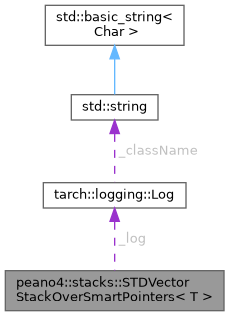
| static tarch::logging::Log | _log |
| Logging device. | |
This stack hosts data of constant size which are stored on the heap and subject to smart pointers.
We assume that that the object stored on the stack
Once we work with smart pointers, we can work with shallow copies as data travel over the individual stacks. This implies that we "only" have to make the clones for the data exchange between threads and ranks actual deep copies.
Special care is however required if we work with solver localisation, i.e. solvers which do not store data in each and every grid entity. If a solver decides not to store a certain piece of data, the underlying value pointer will exist but will point to nullptr. So we may not attempt to deep copy it, but instead need to ensure that the cloned vector will hold nullptr, too.
One tricky aspect in the context of smart pointers is actually the MPI data exchange which has to take into account that data are scattered over the heap. See the documentation of the send/receive operations. They discuss how the business with the required deep copies actually works. Anyway, to make it work, we need the used datatype T to have two fields:
The other tricky thing is that some mesh entities might hold nullptrs. We now have two options:
We go down the latter route. It would be no problem to squeeze out areas in the flattened/gathered area which correspond to nullptr. Yet, if we do so we do not know a priori how big the outgoing data will be. This implies that we have to send out the data in two chunks: First the meta data and then we can trigger the corresponding receive call with a matching size. This is too complicated for me. I just send out everything - including rubbish.
The normal stack works with the STL stack yet never shrinks it. This is to avoid too many memory relocations. Instead, it holds an integer counter which always clarifies how many elements in the STL container hole valid data.
The present container works with the "native" STL container.
| T | Hosts usually pointer which is backed up by a smart pointer, i.e. deleted as soon as noone needs it anymore. T has to provide a clone() operation. |
Definition at line 92 of file STDVectorStackOverSmartPointers.h.
| peano4::stacks::STDVectorStackOverSmartPointers< T >::STDVectorStackOverSmartPointers | ( | ) |
| peano4::stacks::STDVectorStackOverSmartPointers< T >::STDVectorStackOverSmartPointers | ( | const STDVectorStackOverSmartPointers< T > & | ) |
| void peano4::stacks::STDVectorStackOverSmartPointers< T >::clear | ( | ) |
Referenced by peano4.api.output.Makefile.Makefile::__init__().

| void peano4::stacks::STDVectorStackOverSmartPointers< T >::clone | ( | const STDVectorStackOverSmartPointers< T > & | data | ) |
Clone data into the current object on which clone() is called.
This operation overwrites the baseclass version. If we called the plain base class version, we would end up with a shallow copy. However, we want a semi-shallow copy: We replicate the meta data, and then we call the clone() of the actual vector over pointers. It is up to this routine if we craete a shallow copy or not.
Read the class documentation why I think that the clone() on the subvectors should create a deep copy. It is the section on intra-node parallelisation.
This operation has to use the default constructor of T to resize, as we want the destination data structure to be able to host the target data. So it has to issue all the news if required.
| bool peano4::stacks::STDVectorStackOverSmartPointers< T >::empty | ( | ) | const |
|
private |
Allocate buffer and gather.
|
private |
Allocate buffer and gather.
| STDVectorStackOverSmartPointers< T > & peano4::stacks::STDVectorStackOverSmartPointers< T >::operator= | ( | const STDVectorStackOverSmartPointers< T > & | stack | ) |
One is allowed to copy a stack but it has to be empty.
Definition at line 189 of file STDVectorStackOverSmartPointers.h.
References peano4::stacks::STDVectorStackOverSmartPointers< T >::_data, and assertion.
| T peano4::stacks::STDVectorStackOverSmartPointers< T >::pop | ( | ) |
Pops element from a stack.
I have to be careful how and why I use std::move here, as we employ smart pointers. I found that a move after the return confuses the reference counting, and eventually leads to memory leaks.
| PopBlockStackView peano4::stacks::STDVectorStackOverSmartPointers< T >::popBlock | ( | int | numberOfElements | ) |
This operation grabs numberOfElements from the input stack en block and returns a view to it.
Subsequent pops do not affect this block anymore, i.e. the stack is reduced immediately.
| numberOfElements | Size of the view |
|
private |
Mere alloc.
We use the tarch's allocation. Therefore, we can have aligned data here. Without the tarch, the code call would be
_gatheredData = new typename T::DoFType[ size() * T::Cardinality ];
|
private |
Mere alloc.
We use the tarch's allocation. Therefore, we can have aligned data here. Without tarch, the call would be
_gatheredDebugMetaData = new double[ Dimensions*2*size() ];
| void peano4::stacks::STDVectorStackOverSmartPointers< T >::push | ( | const T & | element | ) |
Pushes element to a stack.
| PushBlockStackView peano4::stacks::STDVectorStackOverSmartPointers< T >::pushBlock | ( | int | numberOfElements | ) |
Push a block on the output stack.
| numberOfElements | Size of the view |
| void peano4::stacks::STDVectorStackOverSmartPointers< T >::reverse | ( | ) |
Reversing a stream is something I need extremely rarely.
The biggest application is the realisation of joins through peano4::parallel::SpacetreeSet::streamLocalVertexInformationToMasterThroughVerticalStacks(). Here, I need a streamed version of the tree to get the up-to-date data of the mesh in. However, I don't have streams. I have only stacks. So I map the stream idea to a stack.
|
private |
Scatter received gathered data.
We run over the size keeping in mind that the target has been created over objects with the constructor argument T::ObjectConstruction::NoData. That is, each entry hosts a pointer, but this pointer will currently point to nullptr, as the object is not yet prepared to host any data. We run over the meta data to find out if this is ok, or if we actually want this stack entry to host data. If so, we use the "real" constructor and then copy the raw content over from the gathered data set.
|
private |
| int peano4::stacks::STDVectorStackOverSmartPointers< T >::sendingOrReceiving | ( | ) | const |
I need this one to find out whether I'm waiting for data.
| int peano4::stacks::STDVectorStackOverSmartPointers< T >::size | ( | ) | const |
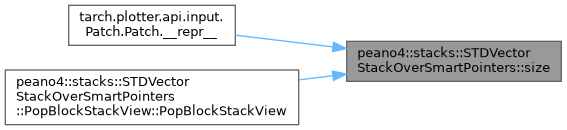
Referenced by tarch.plotter.api.input.Patch.Patch::__repr__(), and peano4::stacks::STDVectorStackOverSmartPointers< T >::PopBlockStackView::PopBlockStackView().
| void peano4::stacks::STDVectorStackOverSmartPointers< T >::startReceive | ( | peano4::grid::TraversalObserver::SendReceiveContext | context, |
| int | rank, | ||
| int | tag, | ||
| MPI_Comm | comm, | ||
| int | numberOfElements | ||
| ) |
Counterpart of startSend()
We have to prepare the en bloc, raw data buffers for both the data and the meta data (if required). After that, we can trigger the two non-blocking receives.
See clone() for a description why we have to use resize() with the standard constructor here.
| void peano4::stacks::STDVectorStackOverSmartPointers< T >::startSend | ( | peano4::grid::TraversalObserver::SendReceiveContext | context, |
| int | rank, | ||
| int | tag, | ||
| MPI_Comm | comm | ||
| ) |
Start the actual send process.
Always pairs up with a finish... call.
As we have to assume that the data of interest are scattered over the main memory, we first allocate one big buffer for the data. This is a buffer over T::DoFType. We then copy the chunks over and send this block rather than the "original" stack data.
The meta data has to be treated (almost) in the same way: In this case, we create manually a buffer over 2 * Dimensions * no of elements doubles and then copy the meta data over one by one. That means: we do not expect T's datatype to encapsulate the meta data - which also doesn't make any sense as T's data itself is scattered over the memory since it works with pointers.
All clean ups are realised within tryToFinishSendOrReceive() where I have to delete the gathered buffer. To save memory overall, I can delete the pointers to the data scattered over the memory straightaway once all is copied over. As these pointers are shared smart pointers, this immediate delete might free memory as the shared pointer counter reduces to zero.
| T & peano4::stacks::STDVectorStackOverSmartPointers< T >::top | ( | int | shift = 0 | ) |
Get top element or shiftth top element.
We start to count with 0, i.e. a shift of 0 (default) really returns the top element. A shift of 3 returns the fourth element from the stack
| const T & peano4::stacks::STDVectorStackOverSmartPointers< T >::top | ( | int | shift = 0 | ) | const |
Get top element or shiftth top element.
We start to count with 0, i.e. a shift of 0 (default) really returns the top element. A shift of 3 returns the fourth element from the stack
| std::string peano4::stacks::STDVectorStackOverSmartPointers< T >::toString | ( | ) | const |
| bool peano4::stacks::STDVectorStackOverSmartPointers< T >::tryToFinishSendOrReceive | ( | ) |
Semantics are alost an exact 1:1 copy of the superclass implementation.
If a send or receive had been pending and just completed, we start the actual clean up process.
As we know that MPI sends in order, we do not have to test for the meta data. Once the real data has dropped in, we know that the meta data are in place, too.
I originally wanted to call the superclass and just free the buffer if its result is true. However, at the time when the result comes back, I do not know if it has just switched from false to true or had been true all along. To avoid complicated logic, I decided to replicate the parent data and to inject the free into the replicated code.
|
private |
This is the attribute holding all the temporary stacks.
Definition at line 102 of file STDVectorStackOverSmartPointers.h.
Referenced by peano4.api.datamodel.DaStGen2.DaStGen2Generator::construct_output(), peano4.api.datamodel.DaStGen2.DaStGen2GeneratorForObjectsWithSmartPointers::construct_output(), peano4.api.toolbox.particles.ParticleSet.ParticleSetGenerator_ScatteredOnHeap_IndexByList::construct_output(), peano4.api.toolbox.particles.ParticleSet.ParticleSetGenerator_ScatteredOnHeap_IndexByVector::construct_output(), peano4.api.toolbox.particles.ParticleSet.ParticleSetGenerator_ContinuousPerVertex::construct_output(), peano4.api.toolbox.particles.ParticleSet.ParticleSetGenerator_GlobalContinuous::construct_output(), peano4.api.datamodel.DaStGen2.DaStGen2Generator::get_header_file_include(), peano4.api.datamodel.DaStGen2.DaStGen2GeneratorForObjectsWithSmartPointers::get_header_file_include(), peano4.api.toolbox.particles.ParticleSet.AbstractParticleSetGenerator::get_header_file_include(), peano4.api.datamodel.DaStGen2.DaStGen2Generator::get_stack_container(), peano4.api.datamodel.DaStGen2.DaStGen2GeneratorForObjectsWithSmartPointers::get_stack_container(), peano4.api.datamodel.DynamicArrayOverPrimitivesToStdVector.DynamicArrayOverPrimitivesToStdVector::get_stack_container(), peano4.api.toolbox.particles.ParticleSet.AbstractParticleSetGenerator::get_stack_container(), peano4::stacks::STDVectorStackOverSmartPointers< T >::operator=(), and peano4::stacks::STDVectorStackOverSmartPointers< T >::PopBlockStackView::PopBlockStackView().
|
private |
See MPI routines below.
This routine holds the actual data in a continuous way.
Definition at line 109 of file STDVectorStackOverSmartPointers.h.
|
private |
Debug data.
Is only used in debug mode to store the x and h values tied to each entry on the stack.
Definition at line 126 of file STDVectorStackOverSmartPointers.h.
|
private |
Meta data with size of memory chunks.
The entries here hold either T::Cardinality or zero. In the latter case, any copy should reconstruct an entry with a nullptr. The entries effectively cluster _gatheredData into chunks.
Definition at line 118 of file STDVectorStackOverSmartPointers.h.
|
private |
Definition at line 135 of file STDVectorStackOverSmartPointers.h.
|
private |
Definition at line 134 of file STDVectorStackOverSmartPointers.h.
|
private |
Definition at line 128 of file STDVectorStackOverSmartPointers.h.
|
private |
Definition at line 133 of file STDVectorStackOverSmartPointers.h.
|
private |
Definition at line 129 of file STDVectorStackOverSmartPointers.h.
|
private |
Definition at line 130 of file STDVectorStackOverSmartPointers.h.
|
staticprivate |
Logging device.
Definition at line 97 of file STDVectorStackOverSmartPointers.h.
 1.9.8