 |
Peano
|
|
Peano
|
#include <TraversalObserver.h>
Public Types | |
| enum class | SendReceiveContext { BoundaryExchange , MultiscaleExchange , ForkDomain , JoinDomain , PeriodicBoundaryDataSwap } |
| There are three different scenarios when we merge data: More... | |
Public Member Functions | |
| virtual | ~TraversalObserver () |
| virtual void | loadCell (const GridTraversalEvent &event)=0 |
| virtual void | enterCell (const GridTraversalEvent &event)=0 |
| Event is invoked per cell. | |
| virtual void | leaveCell (const GridTraversalEvent &event)=0 |
| virtual void | storeCell (const GridTraversalEvent &event)=0 |
| virtual bool | canSkipFullyRemoteCells () const |
| May the spacetree skip cells that carry no information for this observer? | |
| virtual TraversalObserver * | clone (int spacetreeId)=0 |
| virtual std::vector< GridControlEvent > | createGridControlEventsForNextTraversal () const =0 |
| virtual void | beginTraversal (const tarch::la::Vector< Dimensions, double > &x, const tarch::la::Vector< Dimensions, double > &h)=0 |
| Begin the traversal. | |
| virtual void | endTraversal (const tarch::la::Vector< Dimensions, double > &x, const tarch::la::Vector< Dimensions, double > &h)=0 |
| virtual void | exchangeAllVerticalDataExchangeStacks (int) |
| Send local data from top level of local mesh to master and receive its top-down information in return. | |
| virtual void | exchangeAllHorizontalDataExchangeStacks (bool) |
| Exchange all the data along the domain boundaries. | |
| virtual void | exchangeAllPeriodicBoundaryDataStacks () |
| Exchange all periodic boundary data. | |
| virtual void | streamDataFromSplittingTreeToNewTree (int) |
| Stream data from current tree on which this routine is called to the new worker. | |
| virtual void | streamDataFromJoiningTreeToMasterTree (int) |
| virtual void | finishAllOutstandingSendsAndReceives () |
| Wrap up all sends and receives, i.e. | |
| virtual void | sendVertex (int, int, SendReceiveContext, const GridTraversalEvent &) |
| virtual void | sendFace (int, int, SendReceiveContext, const GridTraversalEvent &) |
| virtual void | sendCell (int, SendReceiveContext, const GridTraversalEvent &) |
| virtual void | receiveAndMergeVertex (int, int, SendReceiveContext, const GridTraversalEvent &) |
| virtual void | receiveAndMergeFace (int, int, SendReceiveContext, const GridTraversalEvent &) |
| virtual void | receiveAndMergeCell (int, SendReceiveContext, const GridTraversalEvent &) |
| virtual void | deleteAllStacks () |
Static Public Attributes | |
| static constexpr int | NoRebalancing = -1 |
| static constexpr int | NoData = -1 |
| Can this grid entity hold data. | |
| static constexpr int | CreateOrDestroyPersistentGridEntity = -2 |
| Implies that the data will then be local or had been local. | |
| static constexpr int | CreateOrDestroyHangingGridEntity = -3 |
| Implies that the data will then be local or had been local. | |
There is one observer by grid traversal thread and per rank. The observers are generated from the original observer via the clone() operator. Therefore, you never should be required to write a copy constructor. If you run without multithreading but with MPI, you still have to use a SpacetreeSet. The code therefore continues to copy observers.
Definition at line 36 of file TraversalObserver.h.
|
strong |
There are three different scenarios when we merge data:
There are two more modes: join and fork. It is important to note that these differ from the aforementioned modi, as forks and joins are realised as copies. We do not merge existing data structures, but we copy them. As such, the context fork and the context join do arise when we discuss data exchange. They do never arise when we speak about data merges. If you have a case distinction within a merge, those two modi should be left out (or equipped with assertion). They should be never entered.
| Enumerator | |
|---|---|
| BoundaryExchange | |
| MultiscaleExchange | |
| ForkDomain | |
| JoinDomain | |
| PeriodicBoundaryDataSwap | |
Definition at line 251 of file TraversalObserver.h.
|
virtual |
Definition at line 38 of file TraversalObserver.h.
|
pure virtual |
Begin the traversal.
This routine is called per spacetree instance, i.e. per subtree (thread) per rank. Within the usual implementation, everything will reside on the call stack anyway. If the routine is called on tree no 0, this operation has to establish the master data of the global root tree, i.e. ensure that the data of level -1 is technically there for the subsequent enterCell event, though this data is ill-defined.
| x | Root cell coordinates |
| h | Root cell size |
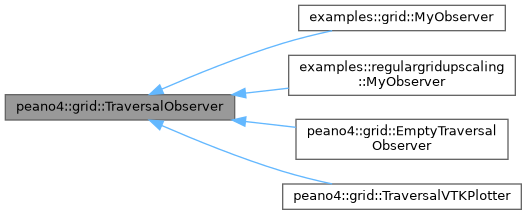
Implemented in examples::grid::MyObserver, examples::regulargridupscaling::MyObserver, peano4::grid::EmptyTraversalObserver, and peano4::grid::TraversalVTKPlotter.
|
virtual |
May the spacetree skip cells that carry no information for this observer?
A cell is fully remote if neither the cell nor any of its faces and vertices is local, and if none of them moves data. Such a cell is not adjacent to any local cell. If an observer returns true, the spacetree does not invoke loadCell(), enterCell(), leaveCell() and storeCell() for these cells. The spacetree still descends into them if they are refined. Skipping is only done for trees that are running and not involved in any dynamic load balancing.
The default is false, as observers such as plotters may want to see all cells. Observers generated by the Python API mask all events of remote entities anyway and return true.
Definition at line 91 of file TraversalObserver.h.
|
pure virtual |
 I use the clone to create one observer object per traversal thread. So
 between different spacetrees of one spacetree set, there can be no race
 condition. Yet, the clone() itself could be called in parallel.

 \section  Global per-sweep actions

 If you want to implement an operation once per sweep in a parallel
 environment, then you can exploit the fact that the spacetree set also
 creates an observer for the global master thread, i.e. tree no 0. So if
 you add a statement alike

 <pre>
if (peano4::parallel::Node::isGlobalMaster(spacetreeId)) { ... }
then you can be sure that the branch body is executed only once globally per grid sweep.
The counterpart of the clone operation is the destructor.
Implemented in examples::grid::MyObserver, examples::regulargridupscaling::MyObserver, peano4::grid::EmptyTraversalObserver, and peano4::grid::TraversalVTKPlotter.
|
pure virtual |
 The tree traversal invokes this operation before beginIteration.

 \section Content
Dynamic AMR is controlled via a sequence of grid control events. Each event spans a certain region and prescribes an h resolution over this region. Depending on the type of the event (erase or refine), the grid adopts. A simple snippet just creating a refined area in a square is
std::vector< peano4::grid::GridControlEvent > applications4::grid::MyObserver::createGridControlEventsForNextTraversal() {
std::vector< peano4::grid::GridControlEvent >  controlEvents;
peano4::grid::GridControlEvent newEvent;
newEvent.setRefinementControl( peano4::grid::GridControlEvent::RefinementControl::Refine );
newEvent.setOffset( {0.0,0.0} );
newEvent.setWidth( {0.5,0.5} );
newEvent.setH( {0.05,0.05} );
controlEvents.push_back(newEvent);
return controlEvents;
}
The entries are logically ordered. The later the entry, the more important it is. So entry 2 overrules entry 1.
Please consult the documentation of grid control events for details on what these events are and how they are used.
Implemented in peano4::grid::EmptyTraversalObserver, and peano4::grid::TraversalVTKPlotter.
|
virtual |
Definition at line 267 of file TraversalObserver.h.
|
pure virtual |
Implemented in examples::grid::MyObserver, examples::regulargridupscaling::MyObserver, peano4::grid::EmptyTraversalObserver, and peano4::grid::TraversalVTKPlotter.
|
pure virtual |
Event is invoked per cell.
It is however not called for the root cell, i.e. for the cell with level 0 that does not have a parent.
Implemented in peano4::grid::EmptyTraversalObserver, peano4::grid::TraversalVTKPlotter, examples::grid::MyObserver, and examples::regulargridupscaling::MyObserver.
|
virtual |
Exchange all the data along the domain boundaries.
If the bool is set, we do send out exactly as many elements per face or vertex as we expect to receive. Therefore, the boundary exchange can optimise the data exchange.
The SpacetreeSet class provides some generic routines for this that you can use. Simply invoke them for every data container that you use. If you trigger non-blocking MPI, you don't have to wait until they are finished. You can expect the calling routine that it calls finishAllOutstandingSendsAndReceives() later on.
Definition at line 198 of file TraversalObserver.h.
|
virtual |
Exchange all periodic boundary data.
Periodic boundary values are always handled by tree 0, i.e. there's no need to distinguish ranks here. On all trees that are not rank 0, this operation should immediately return.
Definition at line 205 of file TraversalObserver.h.
|
virtual |
Send local data from top level of local mesh to master and receive its top-down information in return.
The SpacetreeSet class provides some generic routines for this that you can use. Simply invoke them for every data container that you use. If you trigger non-blocking MPI, you don't have to wait until they are finished. You can expect the calling routine that it calls finishAllOutstandingSendsAndReceives() later on.
Definition at line 184 of file TraversalObserver.h.
|
virtual |
Wrap up all sends and receives, i.e.
invoke wait() on the MPI requests. The SpacetreeSet provides a generic routine for this that you can call per data container in use.
Definition at line 227 of file TraversalObserver.h.
|
pure virtual |
|
pure virtual |
Implemented in peano4::grid::EmptyTraversalObserver, and peano4::grid::TraversalVTKPlotter.
|
virtual |
Definition at line 265 of file TraversalObserver.h.
|
virtual |
Definition at line 264 of file TraversalObserver.h.
|
virtual |
Definition at line 263 of file TraversalObserver.h.
|
virtual |
Definition at line 261 of file TraversalObserver.h.
|
virtual |
Definition at line 260 of file TraversalObserver.h.
|
virtual |
Definition at line 259 of file TraversalObserver.h.
|
pure virtual |
Implemented in peano4::grid::EmptyTraversalObserver, and peano4::grid::TraversalVTKPlotter.
|
virtual |
Definition at line 220 of file TraversalObserver.h.
|
virtual |
Stream data from current tree on which this routine is called to the new worker.
The SpacetreeSet class provides some generic routines for this that you can use. Simply invoke them for every data container that you use. If you trigger non-blocking MPI, you don't have to wait until they are finished. You can expect the calling routine that it calls finishAllOutstandingSendsAndReceives() later on.
Definition at line 219 of file TraversalObserver.h.
|
staticconstexpr |
Implies that the data will then be local or had been local.
Definition at line 62 of file TraversalObserver.h.
|
staticconstexpr |
Implies that the data will then be local or had been local.
Definition at line 57 of file TraversalObserver.h.
|
staticconstexpr |
Can this grid entity hold data.
I use this one to indicate that no data is associated with a grid entity, as the grid entity is outside of the local computational domain. The term refers explicitly to the domain decomposition, i.e. this value is used to flag grid entities which are there in the tree, as we always have to work with full trees, but that cannot really hold any data as the user never sees them.
Definition at line 52 of file TraversalObserver.h.
|
staticconstexpr |
Definition at line 40 of file TraversalObserver.h.
 1.9.8