Simple spherical mass accumulator.
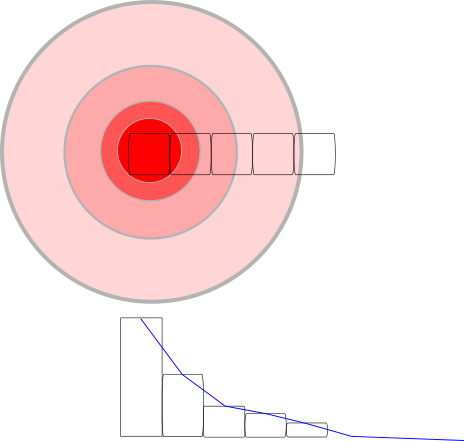
The idea of this accumulator is that you call it for each volume and the accumulator then, well, accumulates these volumes. For this, it splits the domain around a point into shells, and it keeps track how much mass you find per shell. We discretise the domain into shells, and keep track of some 1d data (mass per shell). Most applications don't use the bookkeeping for the actual mass, but only track the mass resulting from overdensities.
Internally, the accumulator holds two copies of the mass: the current one into which we accumulate, and the data from the previous accumulation. This way, we can roll over the data after a time step and thus effectively reset the accumulation, without loosing the original data.
Thread safety and MPI
The class is thread safe. Every rank should have one instance of this class. At the end of each time step, the instances synchronise automatically.
Bucketing
We split the area around a point into shells of fixed size. The number of shells is not fixed a priori, i.e. in theory it could grow as the buckets are built up upon demand.
Interpolation
- Author
- Han Zhang, Tobias Weinzierl
Definition at line 55 of file MassAccumulator.h.
| void applications::exahype2::euler::sphericalaccretion::MassAccumulator::finishAccumulation |
( |
| ) |
|
Finalise data accumulation for next time step.
The routine runs through a sequence of steps:
- Allreduce _currentMass such that all data from all ranks is available on all ranks. The reduction operator is the sum.
- Roll over the current data set into previousMassAccumulated and clear that latter. It is, from now on, available for the next accumulation again.
- Compute accumulated data by running through shells inside-out. _currentMass holds the mass per shell, but eventually we are interested in the accumulated mass, i.e. the integral from the center over the radius r. Note that some shells can be empty as either no (over-)mass is there anymore or a shell was not hit by an integration point or finite volume centre. So the accumulated result is monotonously growing (usually), but the growth is not strict monotonously growing.
- Find out from which radius on the accumulated data makes no big difference anymore. Truncate the data series here. We effectively now know the maximum radius which makes a difference to the mass accumulation.
Cut off radius
For the cut-off radius, I run through all differences between successive accumulated shells/buckets. If two successive buckets have a (relative) difference which is bigger than 1.0+_threshold, i.e. they differ significantly, this is a potential cut-off: the bigger bucket is one we should definitely still take into account. I take the maximum over all of these cut-off candidates.
It is important that we analyse all bucket differences: We cannot stop this analysis early, as some shells might be empty (see reasons above). So even if two buckets i and i+1 do not differ at all, it might still be that i+1 and i+2 differ significantly.

 1.9.8