 |
Peano
|
|
Peano
|
Utility class for global sorting for all flavours of particle sets. More...
#include <SieveParticles.h>
Public Types | |
| typedef T | DoFType |
| typedef std::list< T * > | ParticleList |
Public Member Functions | |
| SieveParticles ()=default | |
| virtual | ~SieveParticles () |
| Destructor. | |
| void | deleteParticles () |
| Deep clear. | |
| void | exchangeSieveListsGlobally (const tarch::la::Vector< Dimensions, double > domainOffset, const tarch::la::Vector< Dimensions, double > domainSize, const std::bitset< Dimensions > periodicBC) |
| Get all the global sieve data consistent. | |
| void | addParticleThatCanNotBeLiftedWithinItsTree (T *) |
| Add a particle to the list of particles which cannot be lifted. | |
| SieveParticles< T > | cloneParticlesToBeSieved () |
| Clone object, but let it contain only the delivering part, i.e. | |
| ParticleList | getParticlesToBeSievedIntoVertex (const peano4::datamanagement::VertexMarker &marker, bool removeReturnedParticlesFromSet, bool onlyReturnParticlesThatWillBeLocal, bool lockSemaphore) |
| Get particles that are to be sieved into one vertex. | |
| bool | hasParticlesToBeSievedIntoVertices () const |
| Fine out how many particles still to sieve. | |
| int | getNumberOfParticlesThatHaveBeSievedIntoVertices () const |
| hasParticlesToBeSievedIntoVertices() is equivalent to checking if this routine returns something greater than 0. | |
| std::string | toString () const |
Static Private Member Functions | |
| static void | deleteParticles (ParticleList &list) |
Private Attributes | |
| ParticleList | _particlesThatCanNotBeLiftedWithinTheirTree |
| ParticleList | _particlesThatHaveToBeSieved |
| Particles that should be sieved. | |
Static Private Attributes | |
| static tarch::logging::Log | _log |
| static int | _SieveReductionTag |
| Reduction tag. | |
| static tarch::multicore::BooleanSemaphore | _particlesThatCanNotBeLiftedWithinTheirTreeSemaphore |
| Semaphores. | |
| static tarch::multicore::BooleanSemaphore | _particlesToBeSievedSemaphore |
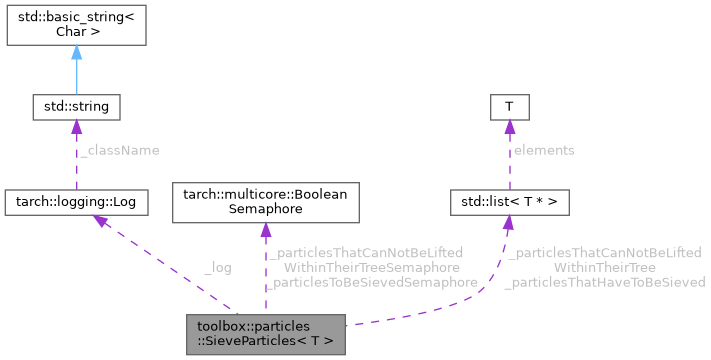
Utility class for global sorting for all flavours of particle sets.
Particle sets and different sorting strategies all differ in the way they actually manage their particles and how they are assigned to the mesh vertices. Notably, they all differ in the way when and how they sort globally. Some sorting strategies such as peano4.toolbox.particles.UpdateParticleGridAssociation_LiftDrop try to realise as much sorting as possible locally by shifting particles between levels and only resort to a global sieve set when particles are very fast, while other strategies such as peano4.toolbox.particles.UpdateParticleGridAssociation_BucketSort generally throw all particles that need to be resorted into the global sieve set and then take it from there.
So sieving means that particles are removed from the global mesh and thrown into a sieve set represented by an instance of SieveParticles. After one mesh traversal, this sieve set is fully populated. After that, the individual subdomains run through their mesh and pick the particles from the global sieve set as they fit. They realise a bucket sort. Again, there are two different ways how to bucket sort:
No matter which strategy you follow, all of them work against the same signature and all of them share the same statistics. These features are provided by this class: The class is used by toolbox.particles.ParticleSet which usually holds one class instance (static attribute) of this class to collect all sieve information. To drop particles from the global sieve set into the respective domains, mesh sweeps either use getParticlesToBeSievedIntoVertex() directly or they create a copy of this sieve set through cloneParticlesToBeSieved() and then hand out particles from this deep copy.
There are few key routines that you should study should you try to use this class:
If particles move around a lot such that the underlying sorting algorithm decides that it would prefer a global sorting step, it adds these particles to the sieve set. If these particles did fly through the domain boundary and now are outside, noone will bucket sort (sieve) them and they will eventually be deleted after the next mesh sweep.
If particles did cross a periodic boundary, they should reenter the domain again: They might, for example, be lifted into the sieve set on the far left and of the domain but should be sorted into the far right one in return. To faciliate this, you have to run through all particles within the sieve set once and apply the periodic boundary conditions to them. This can be done either before exchangeSieveListsGlobally() for the rank-local set of _particlesThatCanNotBeLiftedWithinTheirTree, or is has to be done after the exchange on _particlesThatHaveToBeSieved.
Definition at line 95 of file SieveParticles.h.
| typedef T toolbox::particles::SieveParticles< T >::DoFType |
Definition at line 97 of file SieveParticles.h.
| typedef std::list<T*> toolbox::particles::SieveParticles< T >::ParticleList |
Definition at line 99 of file SieveParticles.h.
|
default |
|
virtual |
Destructor.
The sieve set works with shallow copies, i.e. we assign particles from the mesh and the ownership then goes over into the sieve set. However, when we sort particles into the mesh, each mesh traversal creates its own copy of the particles. The routine cloneParticlesToBeSieved() creates a deep copy.
As we might hand around this deep copy, and as the copy constructor also creates shallow copies, the destructor does not(!) free the memory. You have to do this manually via a call to deleteParticles().
| void toolbox::particles::SieveParticles< T >::addParticleThatCanNotBeLiftedWithinItsTree | ( | T * | ) |
Add a particle to the list of particles which cannot be lifted.
You hand over the pointer to the sieve list. That is, nothing is copied, but the responsibility for this object, from now on, resides with the sieve list. It will eventually delete the particle. Therefore you should not maintain any pointer to the particle anymore once you hand it over to the sieve list.
The routine is thread-safe. The object does not keep any kind of statistics. You have to maintain stats on your own if you need them. However, it only uses the lock, i.e. is thread-safe for originatingTree==GlobalSort.
| SieveParticles< T > toolbox::particles::SieveParticles< T >::cloneParticlesToBeSieved | ( | ) |
Clone object, but let it contain only the delivering part, i.e.
those particles that have to be sieved.
| void toolbox::particles::SieveParticles< T >::deleteParticles | ( | ) |
Deep clear.
|
staticprivate |
| void toolbox::particles::SieveParticles< T >::exchangeSieveListsGlobally | ( | const tarch::la::Vector< Dimensions, double > | domainOffset, |
| const tarch::la::Vector< Dimensions, double > | domainSize, | ||
| const std::bitset< Dimensions > | periodicBC | ||
| ) |
Get all the global sieve data consistent.
Has to be called after the traversal has finished on each rank by the main, i.e. do not call it within the action sets. You may not call this routine more than once per rank per traversal. The core purpose of this routine is to get the global sieve data all consistent: If a tree cannot resort its local particles, and, hence, cannot even synchronise with its neighbours as particles moved too fast, it dumps the particle into the global sieve list. After the traversal, all ranks (and eventually trees) should see the same global sieve list and start to sieve particles into their respective domain.
| int toolbox::particles::SieveParticles< T >::getNumberOfParticlesThatHaveBeSievedIntoVertices | ( | ) | const |
hasParticlesToBeSievedIntoVertices() is equivalent to checking if this routine returns something greater than 0.
| ParticleList toolbox::particles::SieveParticles< T >::getParticlesToBeSievedIntoVertex | ( | const peano4::datamanagement::VertexMarker & | marker, |
| bool | removeReturnedParticlesFromSet, | ||
| bool | onlyReturnParticlesThatWillBeLocal, | ||
| bool | lockSemaphore | ||
| ) |
Get particles that are to be sieved into one vertex.
Takes the current particle set and finds those particles which can be sieved into current vertex. The operation alters the object state of particleList, as it returns the particles that are to be sieved and removes them from the current set.
In line with peano4.toolbox.particles.Particle, we do not alter the parallel state. That's the job of whoever calls this routine. Most action sets (notably our sorting action sets) will invoke the boundary merger and this merger will then take care of the parallel flag.
All the particles in the result set are assigned the correct mesh size h of the corresponding mesh into which we sieve it. So this attribute is changed.
This routine is not static, i.e. we assume it works on a thread-local list of particles. This thread-local list is typically constructed as deep copy of the global sieve list. getSievedParticlesForNextGridTraversal() provides these deep copy semantics. Since we work with a copy of the global particles per thread, there's no need to add semaphores. We are inherently thread-safe. However, we have to delete all left-over particles which have not been sieved by a local thread. As the list had been a deep copy, we'd otherwise create a memory leak.
| originatingTree | Number of tree (positive integer) or GlobalSort. It indicates where the particles should come from, i.e. are they form a specific tree or some particles that we have to sort globally. |
| removeReturnedParticlesFromSet | If this field is set, we remove the particles from the underlying set before we return them. That is, the underlying set on which we call getParticlesToBeSievedIntoVertex() shrinks monotonously. If you set it to false, the particles will reside within the set (for this mesh traversal). Therefore, you should not use the returned particles directly but rather create copies. There is no code at the moment that does not remove the vertex from the set, as we otherwise might sieve the same particle multiple times into the mesh (as the association which particle belongs to which vertex is not absolutely unique). |
| bool toolbox::particles::SieveParticles< T >::hasParticlesToBeSievedIntoVertices | ( | ) | const |
Fine out how many particles still to sieve.
If you ask how many particles we have to sieve, you will receive the ones that have not been sieved so far. Therefore, this routine can not be used for any statistics after a grid sweep to find out how many sieves have been done.
| std::string toolbox::particles::SieveParticles< T >::toString | ( | ) | const |
|
staticprivate |
Definition at line 281 of file SieveParticles.h.
|
private |
Definition at line 315 of file SieveParticles.h.
|
staticprivate |
Semaphores.
This is for the assembly of the set of particles which require global (sieve) data exchange. When we later on sieve the particles into their target vertices, we need another semaphore of its own.
In the present case, the semaphores don't have to be static, as we assume that ParticleSet uses this class as a static class. That is, we implicitly have a static attribute. In return, if someone creates a deep clone of the present particle set through cloneParticlesToBeSieved(), we explicitly don't want the semaphores to lock all other particle sets.
Problems arise once we translate these considerations 1:1 into code, as semaphores cannot be copied. That is, we cannot omit the static keyword. To take the synchronisation remark into account (some routines can work with thread-local copies), we therefore have to make the semaphores static and "just" not lock them if we work with thread-local copies.
Definition at line 312 of file SieveParticles.h.
|
private |
Particles that should be sieved.
This is a set of particles which should be sieved in the next traversal. However, nobody takes particles directly from this list. Instead, tasks will work with their own clones of this list.
The list is populated by finishedTraversal().
Definition at line 328 of file SieveParticles.h.
|
staticprivate |
Definition at line 313 of file SieveParticles.h.
|
staticprivate |
Reduction tag.
We one of these per subclass, i.e. I cannot move it to the superclass
Definition at line 290 of file SieveParticles.h.
 1.9.8