 |
Peano
|
|
Peano
|
Peano's AMR philosophy is guided by few simple principles:
All AMR instructions in Peano are formalised via objects of the type peano4::grid::GridControlEvent. Each event spans a certain geometric area and is either a refine or an erase event. I try to speak of refine and erase and not of refine and coarsen, as the latter is a term used in a multigrid context and usually means that you still keep the fine data somewhere. In contrast, Peano's erase means that the grid is really thrown away.
Prior to a mesh traversal, the routine peano4::grid::Spacetree::traverse() asks the observer for a list of grid control events. The observer's behaviour is generated by __generate_createGridControlEventsForNextTraversal().
So it really just runs through all of its action sets and concatenates the results. While the action sets are persistent attributes of their observer, the observer objects themselves are not.
peano4::parallel::SpacetreeSet::traverse() clones the trees (aka observers).
So that means the events are lost eventually!!!!!!
Also ganz am Anfang fragt er Ganz am Ende fusioniert der Observer ueber seine Actionsets Dazwischen fehlt was? Aber wenn natuerlich dann ein Action Set einen Service anfregt, dann ist alles easy Fuer REgular grid, ruachen wir Zellen also gar nie auswerten!
Prior to each mesh traversal, the automaton running through the mesh asks the active observer hosting one or multiple action sets for a list of grid control events. While is runs through the mesh, it takes these events into account. This happens in three steps:
createGridControlEventsForNextTraversal(). Before we use the events, they are merged/consolidated by peano4::grid::merge().The semantics behind the different grid control flags is natural:
As we work with "at least" semantics all the way through, any refine event overwrites any erase event.
In Peano, a cell is refined, if one of its vertices carries a refinement flag. That is, we flag vertices (not cells), and the cells are refined if the or combination over all vertices yields true.
Consequently, we adhere to the following AMR paradigms:
This behaviour is realised within peano4::grid::Spacetree::evaluateGridControlEvents().
We study two examples of refinement instructions. In the first example, we start from a regular grid (top) and one refinement instruction specifying that a certain area - in this case not aligned with the grid et al should have a smaller mesh size.
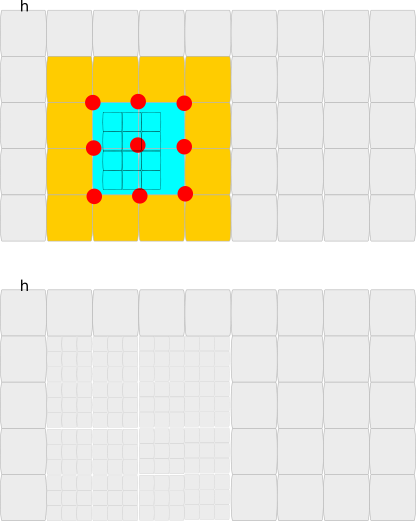
Four cells overlap with the refinement instruction. They set their vertices to refinement-triggered, i.e. nine vertices in total are set to refine. As we have an or-based refinement criterion, this means that all the blueish cells are refined plus the orange ones around them. We end up with the mesh at the bottom.
In the second example, we have an adaptive mesh where an erase condition is imposed with a target mesh size which is just slightly coarser than the h of the right part of the grid.
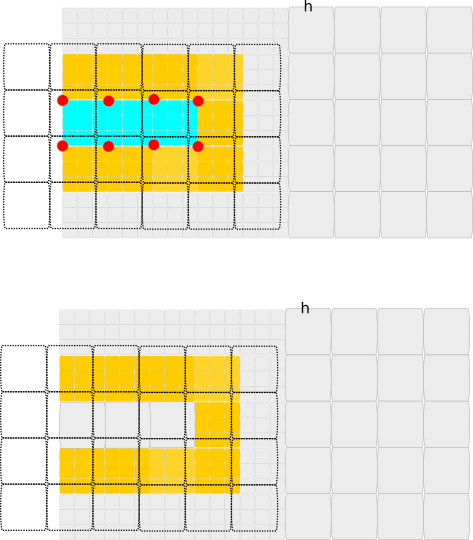
Only refined cells which are overlapped by the erase command together with all of their neighbours are erase candidates. They are marked in blueish, with their adjacent neighbours marked as yellow. Note that Peano thinks in terms of trees and mesh hierarchies. The sketch shows the arising fine grid, but the decision to erase is made on the next coarser mesh within the tree. We end up with four vertices which hold the erase-triggered flag.
As we have an or-based refinement, erasing the vertices means that effectively only the three cells in the centre are coarsened. The other cells remain refined with a lot of adjacent hanging vertices.
In many applications, the refinement pattern is not known a priori. Instead, the action sets build up the knowledge where to refine or coarsen: They start with an empty std::vector< peano4::grid::GridControlEvent >, and push back events throughout the grid run-through. As action sets are not persistent in-between mesh traversal sweeps, as codes might switch between different action sets, and as clones one action set per subdomain (again, the number of subdomains per rank can change over time), we have to be careful with the data management.
A popular pattern is to have a static std::vector< peano4::grid::GridControlEvent >. In this case, an actionset" can build up a local set of control events, and commit them to the
static set. The static set is then returned by <tt>createGridControlEventsForNextTraversal()</tt>
which consequently erases it to accept new events.
To make this work, you might want to work with two static sets: the
currently active one and a new one, as each subspacetree will query
<tt>createGridControlEventsForNextTraversal()</tt> independently. However, we can exploit the fact
that each subtree/subdomain asks for the grid control events before they
actually trigger <tt>beginIteration()</tt>. So it is safe to hand out the
static set and to clear it within the begin iteration.
If you work with multiple @ref glossary_events_and_action_sets "action sets" and an algorithm which switches
between the different ones, you will have to centralise the static
control events. One action set might feed into the event, while the next
one delivers from this centralised repository. Alternatively, you can
add another (static) boolean which you set to true whenever
<tt>createGridControlEventsForNextTraversal()</tt> is invoked. The central events are then cleared
by <tt>beginIteration()</tt> if and only if the boolean is set.
@subsubsection autotoc_md1635 Parallelisation
Peano does not reduce the grid control events globally. That is, if you
have multiple MPI ranks, you have to ensure they exchange their information
with each other. If they don't each MPI rank will refine and erase their
area independently. The mesh will still be consistent, as a vertex along
a boundary which is refined will also trigger a refinement in the remote
neighobur (or-based refinement policy), but there is no global data exchange.
There is a routine peano4::grid::reduceGridControlEvents() that allows you
to reduce information.
@subsubsection autotoc_md1636 Refining the mesh
Due to the or-based refinement criterion, refine instructions tend to spread
through the mesh quite quickly. I therefore recommend that you scale the
refine command down, i.e. make it only cover fragments of a cell. At the same
time, it makes sense to ensure that two cells which trigger a refinement also
trigger two refinement events which are adjacent, as this allows peano4::grid::merge()
to merge them into one larger refinenet instructions. So, as a rule of thumb,
I usually recommend to make refinement events span a mesh size which is around
95% of a cell. The peano4::grid::merge() operation, by default, works with 10%
inaccuracy and then is still able to merge refinement events triggered by
adjacent mesh cells.
@subsubsection autotoc_md1637 Coarsening the mesh
Coarsening a mesh is tricky, as coarsening areas have to span quite some cells
to actively remove mesh cells.
This is a natural consequence of Peano's "at least" policy.
At the same time, you want a coarsening never ever to eliminate a mesh part
that you want, as this might need to oscillations where you erase and refine
and erase again, while it also should not be cancelled out by a refine event
"accidentially".
To enable Peano to erase safely, I usually identify refine cells of which I
want to remove the children, and then I trigger an erase event which has
three times the side line of this very cell. That is, if a cell has the mesh
size h, the erase event has the size 3Ch where the C is a value slightly larger
than 1. I often use 3.1h overall. This means that a cell tells Peano "hey, please erase my children and the children of the neighbours".
Working with these extremely aggressive coarsening factors is important for
refinement patterns which are non hexahedral, and it is important along domain
boundaries, where we cannot hope that a neighbour concatenates their erase
command to ours. Yet, while this will eliminate small refined patches that might
have been left out or are close to the boundary, such an aggressive erase will
leed to oscillations, as we might now ask for an erase over a cell which we
actually wanna keep. <br>
To avoid oscillations, you can introduce a "keep this mesh" event through
artificial refinement instructions. Refinements overwrite erase instructions.
Therefore, you can always trigger a refinement event for a cell which actually
does not refine this cell any further (just make the event span the whole cell
with the cell's mesh size as target mesh size).
Such a refinement event does not refine the mesh any further. However, it
prevents any erase event to remove this part of the mesh. So it is effectively
a "keep the mesh" instruction.
@subsubsection autotoc_md1639 Optimisation
Consult @ref page_peano_performance_optimisation "the generic optimisation remarks" for some details around performance flaws tied to dynamic mesh refinement.
 1.9.8