 |
Peano
|
|
Peano
|
This page collects short, precise definitions of terms that recur throughout Peano's documentation.
Where a term originates from a particular publication, the entry says so and points to the source.
As a traversal runs through the mesh and reports on the steps that it makes to the observer, the observer creates events : touchVertexFirstTime, touchVertexLastTime, touchFaceFirstTime, touchFaceLastTime, and so forth. Events are a logical concepts.
Behaviour can now be injected into the traversal by actually doing something whenever an event arises. Technically, this means that we write a function which does something whenever the event touchFaceFirstTime for example pops up. Unsurprisingly, we call this function touchFaceFirstTime() and we sometimes refer to it as action tied to an event.
All the actions, i.e. functions, are collected in an action set. An action set is simply a collection of functions for the events that can arise if we run through a mesh. Each action set class is tied to an observer. The observer creates the events, i.e. triggers the functions (actions) from the action set. Observers can hold multiple action sets and trigger their functions one by one or in parallel - depending on the action set spec.
These concepts are all mapped 1:1 onto C++, but there are also Python abstractions: The Python class peano4.solversteps.ActionSet consdequently is where a user or extension implements what should actually happen for some of these events.
Action sets and events for the full discussion of all possible actions, including the order in which multiple action sets' events are triggered for the same mesh entity and how to control their order and parallel execution.
The object diagram below illustrates the collaboration for a single event: a spacetree calls traverse() with a TraversalObserver instance, which - while it runs through the mesh - dispatches the resulting event function calls onto the action set instances it holds.

The example above illustrates the core concepts:
Peano's fundamental idea is that there are spacetrees and the user calls Peano to run through these spacetrees. Whenever Peano starts traversing a spacetree, it employs an observer. Logically, an Observer can also be called an algorithmic step** - it is tied to one full, parallel traversal of the mesh ().
As Peano runs through the mesh, it "tells" the observer what mesh transitions is performs. The observer then can move around the data as it sees fit, i.e. load face or cell data from input streams, write data into MPI buffers, and so forth. The observer can also trigger events.
Each observer holds a set of action sets. If the observer identifies an event, these events are forwarded to the action sets, which then map them onto actions. This terminology can be simplified dramatically.
A spacetree is the tree-based adaptive Cartesian mesh data structure underlying Peano. The term is used as a generalisation of the classical quadtree (2D) and octree (3D) data structures to arbitrary dimension \( d \geq 2 \) and to partitionings other than bipartitioning.
The computational domain is scaled and dilated to fit into a unit hypercube of dimension \( d \). This hypercube is cut into \( k \) equidistant slices along each coordinate axis, yielding \( k^d \) small cubes that form a regular Cartesian grid; the cut also defines a parent-child relation between the newly created cubes and the cube they were cut from. This cutting is continued recursively and independently for each new cube. The process terminates in a set of cubes \( \mathcal{T} \) whose leaves, i.e. the cubes that are not refined any further, span an adaptive Cartesian grid, while the parent-child relation (or its inverse) imposes a hierarchy, i.e. a tree, on \( \mathcal{T} \).
Equivalently, if the level \( \ell \) of a tree node is defined as the length of the path from the root (the original bounding box) to that node, the nodes of one level span a regular grid \( \Omega_{h,\ell} \), and the adaptive grid as a whole is \( \Omega_h = \bigcup_\ell \Omega_{h,\ell} \). Tree language and grid language for spacetrees are therefore equivalent, once an adaptive Cartesian grid is read as a composite of disconnected regular Cartesian grids of different resolution, embedded into each other.
Peano tripartitions, i.e. it uses \( k = 3 \), and enumerates/linearises the cells of a spacetree along a Peano space-filling curve rather than via plain depth-first or breadth-first search, since a space-filling-curve-based enumeration turns the tree's parent-child partial order into a total order and yields, among other properties, face-connected traversal steps.
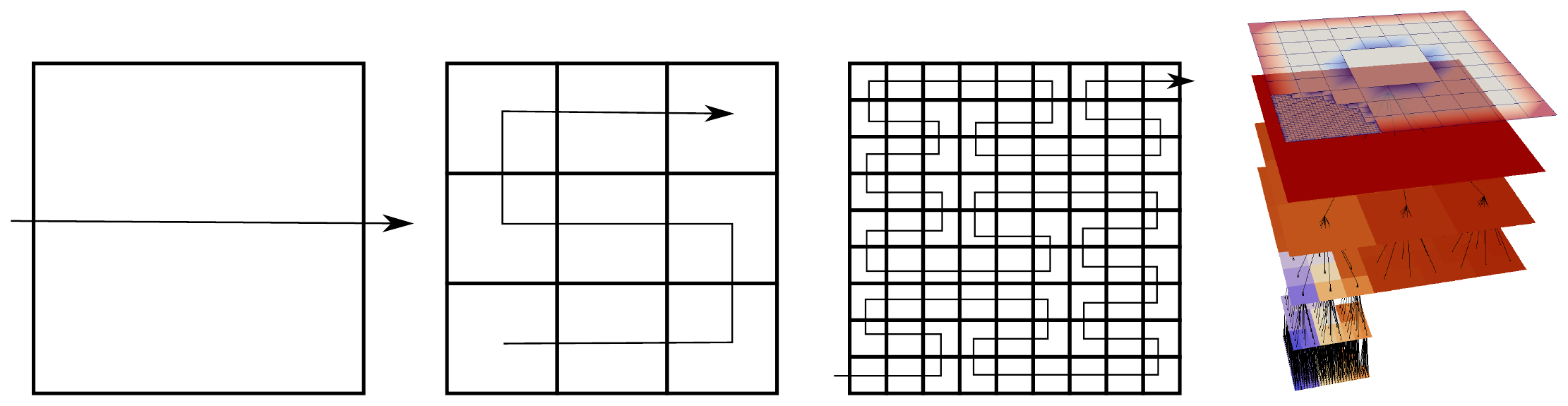
Figure reproduced from: T. Weinzierl, "The Peano Software—Parallel, Automaton-based, Dynamically Adaptive Grid Traversals," ACM Transactions on Mathematical Software, 45(2), Article 14, 2019, doi:10.1145/3319797 (arXiv:1506.04496).
The four panels of the figure, left to right, show: the computational domain embedded into a square; the Peano space-filling curve motif inducing an ordering on the \( 3 \times 3 \) Cartesian grid obtained from one refinement step of that square; the same construction after a further refinement step, still following the Peano curve; and, on top, an adaptively refined Cartesian grid with, below it, the corresponding spacetree.
 1.9.8