 |
Peano
|
|
Peano
|
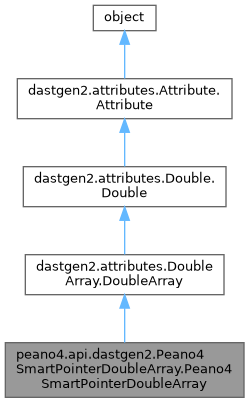
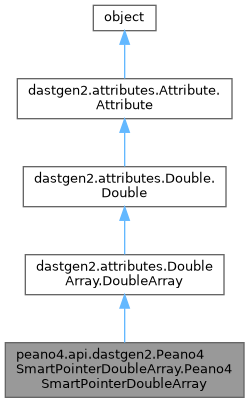
Specialisation of array using Peano's tarch with a smart pointer. More...
Public Member Functions | |
| __init__ (self, name, cardinality, ifdefs=[]) | |
| See superclass' constructor. | |
| get_methods (self, _full_qualified_class_name, for_declaration=True) | |
| This routine defines which operations the generated data type offers. | |
| use_default_copy_constructor (self) | |
| Cannot use the default copy constructor, as it is an array, i.e. | |
| get_plain_C_attributes (self, for_constructor=False) | |
| Return list of n-tuples. | |
| get_first_plain_C_attribute (self) | |
| For MPI for example, I need to know the first attribute. | |
| get_constructor_arguments (self) | |
| Return list of tuple of arguments for the constructor. | |
| get_method_body (self, signature) | |
| I hand in the method signature (see get_methods()) and wanna get the whole implementation. | |
| get_native_MPI_type (self) | |
| Return native (built-in) MPI datatype. | |
| get_to_string (self) | |
| Return string representation of attribute. | |
 Public Member Functions inherited from dastgen2.attributes.DoubleArray.DoubleArray | |
| valid_mantissa_bits (self) | |
| valid_mantissa_bits (self, value) | |
| Set mantissa used. | |
| Public Member Functions inherited from dastgen2.attributes.Attribute.Attribute | |
| get_public_fields (self) | |
| Return string that is to be embedded into the public part of the class definition. | |
| get_attribute_declaration_string (self) | |
| Construct the string used for variable declaration using the output of get_plain_C_attributes(self). | |
| get_accessor_name (self) | |
| Generate the accessor name used throughout dastgen2 to create variables, function names, etc. | |
| name (self) | |
| I expect that there's at least one setter/getter pair. | |
| get_includes (self) | |
Protected Attributes | |
| _cardinality | |
| _name | |
| Protected Attributes inherited from dastgen2.attributes.DoubleArray.DoubleArray | |
| _cardinality | |
| _valid_mantissa_bits | |
| Protected Attributes inherited from dastgen2.attributes.Double.Double | |
| _valid_mantissa_bits | |
| _is_constexpr | |
| Protected Attributes inherited from dastgen2.attributes.Attribute.Attribute | |
| _name | |
| _initval | |
Additional Inherited Members | |
| Data Fields inherited from dastgen2.attributes.Attribute.Attribute | |
| use_data_store | |
| ifdefs | |
| qualifier | |
| expose_in_header_file | |
| Protected Member Functions inherited from dastgen2.attributes.Attribute.Attribute | |
| _is_static (self) | |
| _is_const_static (self) | |
| _is_const (self) | |
| _is_constexpr (self) | |
Specialisation of array using Peano's tarch with a smart pointer.
This routine maps a logical array of fixed size onto a smart pointer class. If you use it, the resulting element tied to a cell, face or vertex might induce significantly lower memory movement overhead. However, this is not guaranteed, and requires some careful testing. As you work with smart pointers, the routine gives you direct access to the underlying vector, i.e. provides specialised routines that expose the underlying data structure: There are the standard getters and setters, but there are also variants which give you the start pointer data object, while get and set are compatible with Peano4DoubleArray's signature.
Using this class is straightforward and doesn't seem to be any different to Peano4DoubleArray. However, under the hood you'll alter the behaviour of peano4.api.datamodel.DaStGen2.
Definition at line 6 of file Peano4SmartPointerDoubleArray.py.
| peano4.api.dastgen2.Peano4SmartPointerDoubleArray.Peano4SmartPointerDoubleArray.__init__ | ( | self, | |
| name, | |||
| cardinality, | |||
ifdefs = [] |
|||
| ) |
See superclass' constructor.
| cardinality | String This is important: It is not (necessarily) an integer, but can be a string which is defined via a pragma or constexpr later. |
Reimplemented from dastgen2.attributes.DoubleArray.DoubleArray.
Definition at line 27 of file Peano4SmartPointerDoubleArray.py.
References peano4.api.dastgen2.Peano4SmartPointerDoubleArray.Peano4SmartPointerDoubleArray.__init__().
Referenced by peano4.api.dastgen2.Peano4SmartPointerDoubleArray.Peano4SmartPointerDoubleArray.__init__().
| peano4.api.dastgen2.Peano4SmartPointerDoubleArray.Peano4SmartPointerDoubleArray.get_constructor_arguments | ( | self | ) |
Return list of tuple of arguments for the constructor.
The first tuple entry is the name, the second one the type. By default, I take them from the plain C attributes, but you can alter this behaviour.
Reimplemented from dastgen2.attributes.Attribute.Attribute.
Definition at line 96 of file Peano4SmartPointerDoubleArray.py.
References dastgen2.attributes.BooleanArray.BooleanArray._cardinality, dastgen2.attributes.DoubleArray.DoubleArray._cardinality, dastgen2.attributes.IntegerArray.IntegerArray._cardinality, peano4.api.dastgen2.Peano4DoubleArray.Peano4DoubleArray._cardinality, peano4.api.dastgen2.Peano4IntegerArray.Peano4IntegerArray._cardinality, peano4.api.dastgen2.Peano4SmartPointerDoubleArray.Peano4SmartPointerDoubleArray._cardinality, solvers.aderdg.ADERDG.ADERDG._name, solvers.elliptic.AMRMarker.AMRMarker._name, solvers.elliptic.ConstrainedPoissonEquationForMarkerOnCells.ConstrainedPoissonEquationForMarkerOnCells._name, solvers.fv.EnclaveTasking.EnclaveTasking._name, solvers.fv.FV.FV._name, solvers.limiting.PosterioriLimiting.PosterioriLimiting._name, solvers.limiting.StaticLimiting.StaticLimiting._name, solvers.rkdg.RungeKuttaDG.RungeKuttaDG._name, solvers.rkdg.SeparateSweeps.SeparateSweeps._name, solvers.rkdg.SeparateSweepsWithEnclaveTasking.SeparateSweepsWithEnclaveTasking._name, dastgen2.attributes.Attribute.Attribute._name, dastgen2.attributes.BooleanArray.BooleanArray._name, dastgen2.attributes.Enumeration.Enumeration._name, exahype2.api.dslhype.SyntaxTree.MemoryAllocation._name, exahype2.api.dslhype.SyntaxTree.MemoryDeallocation._name, exahype2.api.dslhype.SyntaxTree.Construction._name, exahype2.api.dslhype.SyntaxTree.DataBlockConstructionFromExisting._name, exahype2.api.dslhype.SyntaxTree.DataBlockConstructionFromOperation._name, exahype2.api.dslhype.SyntaxTree.DataBlockConstructionFromMatrixVectorProduct._name, exahype2.api.dslhype.SyntaxTree.DataBlockConstructionFromDotProduct._name, exahype2.api.dslhype.SyntaxTree.DataBlockConstructionFromFunction._name, exahype2.api.Solver.Solver._name, solvers.api.Solver.Solver._name, mghype::matrixfree::solvers::Solver._name, api.solvers.Solver.Solver._name, peano4.api.dastgen2.Peano4DoubleArray.Peano4DoubleArray._name, peano4.api.dastgen2.Peano4IntegerArray.Peano4IntegerArray._name, peano4.api.dastgen2.Peano4SmartPointerDoubleArray.Peano4SmartPointerDoubleArray._name, peano4::RunMultipleSteps._name, tarch::services::ServiceRepository::ServiceEntry._name, and api.Tree.Tree._name.
| peano4.api.dastgen2.Peano4SmartPointerDoubleArray.Peano4SmartPointerDoubleArray.get_first_plain_C_attribute | ( | self | ) |
For MPI for example, I need to know the first attribute.
If you map your attribute onto multiple data types, it is one type that represents the whole thing.
Reimplemented from dastgen2.attributes.DoubleArray.DoubleArray.
Definition at line 93 of file Peano4SmartPointerDoubleArray.py.
References solvers.aderdg.ADERDG.ADERDG._name, solvers.elliptic.AMRMarker.AMRMarker._name, solvers.elliptic.ConstrainedPoissonEquationForMarkerOnCells.ConstrainedPoissonEquationForMarkerOnCells._name, solvers.fv.EnclaveTasking.EnclaveTasking._name, solvers.fv.FV.FV._name, solvers.limiting.PosterioriLimiting.PosterioriLimiting._name, solvers.limiting.StaticLimiting.StaticLimiting._name, solvers.rkdg.RungeKuttaDG.RungeKuttaDG._name, solvers.rkdg.SeparateSweeps.SeparateSweeps._name, solvers.rkdg.SeparateSweepsWithEnclaveTasking.SeparateSweepsWithEnclaveTasking._name, dastgen2.attributes.Attribute.Attribute._name, dastgen2.attributes.BooleanArray.BooleanArray._name, dastgen2.attributes.Enumeration.Enumeration._name, exahype2.api.dslhype.SyntaxTree.MemoryAllocation._name, exahype2.api.dslhype.SyntaxTree.MemoryDeallocation._name, exahype2.api.dslhype.SyntaxTree.Construction._name, exahype2.api.dslhype.SyntaxTree.DataBlockConstructionFromExisting._name, exahype2.api.dslhype.SyntaxTree.DataBlockConstructionFromOperation._name, exahype2.api.dslhype.SyntaxTree.DataBlockConstructionFromMatrixVectorProduct._name, exahype2.api.dslhype.SyntaxTree.DataBlockConstructionFromDotProduct._name, exahype2.api.dslhype.SyntaxTree.DataBlockConstructionFromFunction._name, exahype2.api.Solver.Solver._name, solvers.api.Solver.Solver._name, mghype::matrixfree::solvers::Solver._name, api.solvers.Solver.Solver._name, peano4.api.dastgen2.Peano4DoubleArray.Peano4DoubleArray._name, peano4.api.dastgen2.Peano4IntegerArray.Peano4IntegerArray._name, peano4.api.dastgen2.Peano4SmartPointerDoubleArray.Peano4SmartPointerDoubleArray._name, peano4::RunMultipleSteps._name, tarch::services::ServiceRepository::ServiceEntry._name, and api.Tree.Tree._name.
| peano4.api.dastgen2.Peano4SmartPointerDoubleArray.Peano4SmartPointerDoubleArray.get_method_body | ( | self, | |
| signature | |||
| ) |
I hand in the method signature (see get_methods()) and wanna get the whole implementation.
Reimplemented from dastgen2.attributes.DoubleArray.DoubleArray.
Definition at line 101 of file Peano4SmartPointerDoubleArray.py.
References solvers.aderdg.ADERDG.ADERDG._name, solvers.elliptic.AMRMarker.AMRMarker._name, solvers.elliptic.ConstrainedPoissonEquationForMarkerOnCells.ConstrainedPoissonEquationForMarkerOnCells._name, solvers.fv.EnclaveTasking.EnclaveTasking._name, solvers.fv.FV.FV._name, solvers.limiting.PosterioriLimiting.PosterioriLimiting._name, solvers.limiting.StaticLimiting.StaticLimiting._name, solvers.rkdg.RungeKuttaDG.RungeKuttaDG._name, solvers.rkdg.SeparateSweeps.SeparateSweeps._name, solvers.rkdg.SeparateSweepsWithEnclaveTasking.SeparateSweepsWithEnclaveTasking._name, dastgen2.attributes.Attribute.Attribute._name, dastgen2.attributes.BooleanArray.BooleanArray._name, dastgen2.attributes.Enumeration.Enumeration._name, exahype2.api.dslhype.SyntaxTree.MemoryAllocation._name, exahype2.api.dslhype.SyntaxTree.MemoryDeallocation._name, exahype2.api.dslhype.SyntaxTree.Construction._name, exahype2.api.dslhype.SyntaxTree.DataBlockConstructionFromExisting._name, exahype2.api.dslhype.SyntaxTree.DataBlockConstructionFromOperation._name, exahype2.api.dslhype.SyntaxTree.DataBlockConstructionFromMatrixVectorProduct._name, exahype2.api.dslhype.SyntaxTree.DataBlockConstructionFromDotProduct._name, exahype2.api.dslhype.SyntaxTree.DataBlockConstructionFromFunction._name, exahype2.api.Solver.Solver._name, solvers.api.Solver.Solver._name, mghype::matrixfree::solvers::Solver._name, api.solvers.Solver.Solver._name, peano4.api.dastgen2.Peano4DoubleArray.Peano4DoubleArray._name, peano4.api.dastgen2.Peano4IntegerArray.Peano4IntegerArray._name, peano4.api.dastgen2.Peano4SmartPointerDoubleArray.Peano4SmartPointerDoubleArray._name, peano4::RunMultipleSteps._name, tarch::services::ServiceRepository::ServiceEntry._name, api.Tree.Tree._name, and dastgen2.attributes.Attribute.Attribute.use_data_store.
| peano4.api.dastgen2.Peano4SmartPointerDoubleArray.Peano4SmartPointerDoubleArray.get_methods | ( | self, | |
| _full_qualified_class_name, | |||
for_declaration = True |
|||
| ) |
This routine defines which operations the generated data type offers.
It is very much the same as Peano4DoubleArray, i.e. it hides the underlying smart pointers. If the user calls get, the data is converted into a normal tarch vector. If the user calls set, we take the argument and copy it into the underlying smart pointer.
However, we add one more routine: getXXXXSmartPointer(). This way, users can get access to the smart pointer data under the hood.
Reimplemented from dastgen2.attributes.DoubleArray.DoubleArray.
Definition at line 46 of file Peano4SmartPointerDoubleArray.py.
References dastgen2.attributes.BooleanArray.BooleanArray._cardinality, dastgen2.attributes.DoubleArray.DoubleArray._cardinality, dastgen2.attributes.IntegerArray.IntegerArray._cardinality, peano4.api.dastgen2.Peano4DoubleArray.Peano4DoubleArray._cardinality, peano4.api.dastgen2.Peano4IntegerArray.Peano4IntegerArray._cardinality, peano4.api.dastgen2.Peano4SmartPointerDoubleArray.Peano4SmartPointerDoubleArray._cardinality, solvers.aderdg.ADERDG.ADERDG._name, solvers.elliptic.AMRMarker.AMRMarker._name, solvers.elliptic.ConstrainedPoissonEquationForMarkerOnCells.ConstrainedPoissonEquationForMarkerOnCells._name, solvers.fv.EnclaveTasking.EnclaveTasking._name, solvers.fv.FV.FV._name, solvers.limiting.PosterioriLimiting.PosterioriLimiting._name, solvers.limiting.StaticLimiting.StaticLimiting._name, solvers.rkdg.RungeKuttaDG.RungeKuttaDG._name, solvers.rkdg.SeparateSweeps.SeparateSweeps._name, solvers.rkdg.SeparateSweepsWithEnclaveTasking.SeparateSweepsWithEnclaveTasking._name, dastgen2.attributes.Attribute.Attribute._name, dastgen2.attributes.BooleanArray.BooleanArray._name, dastgen2.attributes.Enumeration.Enumeration._name, exahype2.api.dslhype.SyntaxTree.MemoryAllocation._name, exahype2.api.dslhype.SyntaxTree.MemoryDeallocation._name, exahype2.api.dslhype.SyntaxTree.Construction._name, exahype2.api.dslhype.SyntaxTree.DataBlockConstructionFromExisting._name, exahype2.api.dslhype.SyntaxTree.DataBlockConstructionFromOperation._name, exahype2.api.dslhype.SyntaxTree.DataBlockConstructionFromMatrixVectorProduct._name, exahype2.api.dslhype.SyntaxTree.DataBlockConstructionFromDotProduct._name, exahype2.api.dslhype.SyntaxTree.DataBlockConstructionFromFunction._name, exahype2.api.Solver.Solver._name, solvers.api.Solver.Solver._name, mghype::matrixfree::solvers::Solver._name, api.solvers.Solver.Solver._name, peano4.api.dastgen2.Peano4DoubleArray.Peano4DoubleArray._name, peano4.api.dastgen2.Peano4IntegerArray.Peano4IntegerArray._name, peano4.api.dastgen2.Peano4SmartPointerDoubleArray.Peano4SmartPointerDoubleArray._name, peano4::RunMultipleSteps._name, tarch::services::ServiceRepository::ServiceEntry._name, and api.Tree.Tree._name.
| peano4.api.dastgen2.Peano4SmartPointerDoubleArray.Peano4SmartPointerDoubleArray.get_native_MPI_type | ( | self | ) |
Return native (built-in) MPI datatype.
Return None if there's no direct mapping. The actual result is not a string only, but a list of tuples from native type to cardinality.
Reimplemented from dastgen2.attributes.DoubleArray.DoubleArray.
Definition at line 130 of file Peano4SmartPointerDoubleArray.py.
References dastgen2.attributes.BooleanArray.BooleanArray._cardinality, dastgen2.attributes.DoubleArray.DoubleArray._cardinality, dastgen2.attributes.IntegerArray.IntegerArray._cardinality, peano4.api.dastgen2.Peano4DoubleArray.Peano4DoubleArray._cardinality, peano4.api.dastgen2.Peano4IntegerArray.Peano4IntegerArray._cardinality, and peano4.api.dastgen2.Peano4SmartPointerDoubleArray.Peano4SmartPointerDoubleArray._cardinality.
| peano4.api.dastgen2.Peano4SmartPointerDoubleArray.Peano4SmartPointerDoubleArray.get_plain_C_attributes | ( | self, | |
for_constructor = False |
|||
| ) |
Return list of n-tuples.
The tuple can either host two, three or four entries. The list itself may contain arbitrary many tuples, as one attribute logically can map onto multiple technical attributes. For example, when declaring an array, also declare an integer variable containing its length.
for_constructor: bool whether the return value of this function is intended for use in the constructor method of the DataModel. If true, will omit (optionally provided) initialization values in the attribute string.
The first triple entry always is the name, the second one the type. Type has to be plain C.
The first triple entry always is the name, the second one the type. Type has to be plain C. The third entry is a C++ attribute, i.e. a string embedded into [[...]].
The first triple entry always is the name, the second one the type. Type has to be plain C. The third entry is a C++ attribute, i.e. a string embedded into [[...]]. The fourth attribute is a list of ifdef symbols that have to be defined to use this attribute. The list of symbols is concatenated with an and. You can return an empty list. All symbol definitions can also be expressions such sa DEBUG>0 or defined(DEBUG).
Please note that these latter ifdefs are something completely different than the base class ifdefs. The base class ifdefs are to be used if you want to switch attributes on and off. The attributes here are used to switch between realisation variants.
Arrays can be modelled by adding a cardinality ("[15]" for example) to the first triple entry, i.e. the name.
Reimplemented from dastgen2.attributes.DoubleArray.DoubleArray.
Definition at line 85 of file Peano4SmartPointerDoubleArray.py.
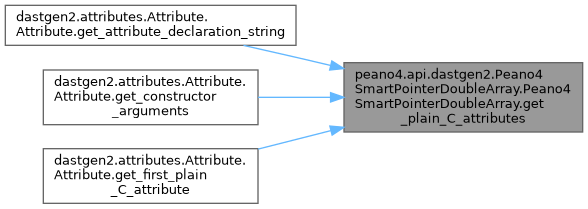
Referenced by dastgen2.attributes.Attribute.Attribute.get_attribute_declaration_string(), dastgen2.attributes.Attribute.Attribute.get_constructor_arguments(), and dastgen2.attributes.Attribute.Attribute.get_first_plain_C_attribute().
| peano4.api.dastgen2.Peano4SmartPointerDoubleArray.Peano4SmartPointerDoubleArray.get_to_string | ( | self | ) |
Return string representation of attribute.
Reimplemented from dastgen2.attributes.DoubleArray.DoubleArray.
Definition at line 133 of file Peano4SmartPointerDoubleArray.py.
References solvers.aderdg.ADERDG.ADERDG._name, solvers.elliptic.AMRMarker.AMRMarker._name, solvers.elliptic.ConstrainedPoissonEquationForMarkerOnCells.ConstrainedPoissonEquationForMarkerOnCells._name, solvers.fv.EnclaveTasking.EnclaveTasking._name, solvers.fv.FV.FV._name, solvers.limiting.PosterioriLimiting.PosterioriLimiting._name, solvers.limiting.StaticLimiting.StaticLimiting._name, solvers.rkdg.RungeKuttaDG.RungeKuttaDG._name, solvers.rkdg.SeparateSweeps.SeparateSweeps._name, solvers.rkdg.SeparateSweepsWithEnclaveTasking.SeparateSweepsWithEnclaveTasking._name, dastgen2.attributes.Attribute.Attribute._name, dastgen2.attributes.BooleanArray.BooleanArray._name, dastgen2.attributes.Enumeration.Enumeration._name, exahype2.api.dslhype.SyntaxTree.MemoryAllocation._name, exahype2.api.dslhype.SyntaxTree.MemoryDeallocation._name, exahype2.api.dslhype.SyntaxTree.Construction._name, exahype2.api.dslhype.SyntaxTree.DataBlockConstructionFromExisting._name, exahype2.api.dslhype.SyntaxTree.DataBlockConstructionFromOperation._name, exahype2.api.dslhype.SyntaxTree.DataBlockConstructionFromMatrixVectorProduct._name, exahype2.api.dslhype.SyntaxTree.DataBlockConstructionFromDotProduct._name, exahype2.api.dslhype.SyntaxTree.DataBlockConstructionFromFunction._name, exahype2.api.Solver.Solver._name, solvers.api.Solver.Solver._name, mghype::matrixfree::solvers::Solver._name, api.solvers.Solver.Solver._name, peano4.api.dastgen2.Peano4DoubleArray.Peano4DoubleArray._name, peano4.api.dastgen2.Peano4IntegerArray.Peano4IntegerArray._name, peano4.api.dastgen2.Peano4SmartPointerDoubleArray.Peano4SmartPointerDoubleArray._name, peano4::RunMultipleSteps._name, tarch::services::ServiceRepository::ServiceEntry._name, api.Tree.Tree._name, and dastgen2.attributes.Attribute.Attribute.use_data_store.
| peano4.api.dastgen2.Peano4SmartPointerDoubleArray.Peano4SmartPointerDoubleArray.use_default_copy_constructor | ( | self | ) |
Cannot use the default copy constructor, as it is an array, i.e.
we need some manual deep copying.
Reimplemented from dastgen2.attributes.DoubleArray.DoubleArray.
Definition at line 82 of file Peano4SmartPointerDoubleArray.py.
|
protected |
Definition at line 44 of file Peano4SmartPointerDoubleArray.py.
Referenced by dastgen2.attributes.BooleanArray.BooleanArray.get_constructor_arguments(), peano4.api.dastgen2.Peano4DoubleArray.Peano4DoubleArray.get_constructor_arguments(), peano4.api.dastgen2.Peano4IntegerArray.Peano4IntegerArray.get_constructor_arguments(), peano4.api.dastgen2.Peano4SmartPointerDoubleArray.Peano4SmartPointerDoubleArray.get_constructor_arguments(), dastgen2.attributes.BooleanArray.BooleanArray.get_method_body(), dastgen2.attributes.DoubleArray.DoubleArray.get_method_body(), dastgen2.attributes.IntegerArray.IntegerArray.get_method_body(), peano4.api.dastgen2.Peano4DoubleArray.Peano4DoubleArray.get_method_body(), peano4.api.dastgen2.Peano4IntegerArray.Peano4IntegerArray.get_method_body(), dastgen2.attributes.BooleanArray.BooleanArray.get_methods(), dastgen2.attributes.DoubleArray.DoubleArray.get_methods(), dastgen2.attributes.IntegerArray.IntegerArray.get_methods(), peano4.api.dastgen2.Peano4DoubleArray.Peano4DoubleArray.get_methods(), peano4.api.dastgen2.Peano4IntegerArray.Peano4IntegerArray.get_methods(), peano4.api.dastgen2.Peano4SmartPointerDoubleArray.Peano4SmartPointerDoubleArray.get_methods(), dastgen2.attributes.DoubleArray.DoubleArray.get_native_MPI_type(), dastgen2.attributes.IntegerArray.IntegerArray.get_native_MPI_type(), peano4.api.dastgen2.Peano4DoubleArray.Peano4DoubleArray.get_native_MPI_type(), peano4.api.dastgen2.Peano4IntegerArray.Peano4IntegerArray.get_native_MPI_type(), peano4.api.dastgen2.Peano4SmartPointerDoubleArray.Peano4SmartPointerDoubleArray.get_native_MPI_type(), dastgen2.attributes.BooleanArray.BooleanArray.get_plain_C_attributes(), dastgen2.attributes.DoubleArray.DoubleArray.get_plain_C_attributes(), dastgen2.attributes.IntegerArray.IntegerArray.get_plain_C_attributes(), peano4.api.dastgen2.Peano4DoubleArray.Peano4DoubleArray.get_plain_C_attributes(), and peano4.api.dastgen2.Peano4IntegerArray.Peano4IntegerArray.get_plain_C_attributes().
|
protected |
Definition at line 88 of file Peano4SmartPointerDoubleArray.py.
Referenced by solvers.aderdg.ADERDG.ADERDG.__str__(), solvers.elliptic.AMRMarker.AMRMarker.__str__(), solvers.elliptic.ConstrainedPoissonEquationForMarkerOnCells.ConstrainedPoissonEquationForMarkerOnCells.__str__(), solvers.fv.FV.FV.__str__(), solvers.rkdg.RungeKuttaDG.RungeKuttaDG.__str__(), exahype2.api.Solver.Solver.__str__(), solvers.api.Solver.Solver.__str__(), api.Tree.Tree.__str__(), solvers.fv.EnclaveTasking.EnclaveTasking._enclave_task_name(), dastgen2.attributes.Enumeration.Enumeration._enum_name(), solvers.aderdg.ADERDG.ADERDG._generate_kernels(), solvers.aderdg.ADERDG.ADERDG._init_dictionary_with_default_parameters(), solvers.fv.FV.FV._init_dictionary_with_default_parameters(), solvers.rkdg.RungeKuttaDG.RungeKuttaDG._init_dictionary_with_default_parameters(), solvers.aderdg.ADERDG.ADERDG._interpolate_face_data_default_guard(), solvers.aderdg.SingleSweep.SingleSweep._interpolate_face_data_default_guard(), solvers.aderdg.ADERDG.ADERDG._load_cell_data_default_guard(), solvers.fv.FV.FV._load_cell_data_default_guard(), solvers.rkdg.RungeKuttaDG.RungeKuttaDG._load_cell_data_default_guard(), solvers.aderdg.ADERDG.ADERDG._load_face_data_default_guard(), solvers.fv.FV.FV._load_face_data_default_guard(), solvers.rkdg.RungeKuttaDG.RungeKuttaDG._load_face_data_default_guard(), solvers.aderdg.ADERDG.ADERDG._provide_cell_data_to_compute_kernels_default_guard(), solvers.fv.FV.FV._provide_cell_data_to_compute_kernels_default_guard(), solvers.rkdg.RungeKuttaDG.RungeKuttaDG._provide_cell_data_to_compute_kernels_default_guard(), solvers.aderdg.ADERDG.ADERDG._provide_face_data_to_compute_kernels_default_guard(), solvers.fv.FV.FV._provide_face_data_to_compute_kernels_default_guard(), solvers.rkdg.RungeKuttaDG.RungeKuttaDG._provide_face_data_to_compute_kernels_default_guard(), solvers.aderdg.SingleSweep.SingleSweep._restrict_face_data_default_guard(), solvers.aderdg.ADERDG.ADERDG._store_boundary_data_default_guard(), solvers.aderdg.ADERDG.ADERDG._store_cell_data_default_guard(), solvers.fv.FV.FV._store_cell_data_default_guard(), solvers.rkdg.RungeKuttaDG.RungeKuttaDG._store_cell_data_default_guard(), solvers.aderdg.ADERDG.ADERDG._store_face_data_default_guard(), solvers.fv.FV.FV._store_face_data_default_guard(), solvers.rkdg.RungeKuttaDG.RungeKuttaDG._store_face_data_default_guard(), solvers.aderdg.ADERDG.ADERDG._unknown_identifier(), solvers.elliptic.AMRMarker.AMRMarker._unknown_identifier(), solvers.elliptic.ConstrainedPoissonEquationForMarkerOnCells.ConstrainedPoissonEquationForMarkerOnCells._unknown_identifier(), solvers.fv.FV.FV._unknown_identifier(), solvers.rkdg.RungeKuttaDG.RungeKuttaDG._unknown_identifier(), exahype2.api.Solver.Solver._unknown_identifier(), solvers.fv.FV.FV.add_actions_to_checkpoint_solution(), solvers.fv.EnclaveTasking.EnclaveTasking.add_actions_to_create_grid(), solvers.fv.EnclaveTasking.EnclaveTasking.add_actions_to_init_grid(), solvers.aderdg.ADERDG.ADERDG.add_actions_to_plot_solution(), solvers.elliptic.ConstrainedPoissonEquationForMarkerOnCells.ConstrainedPoissonEquationForMarkerOnCells.add_actions_to_plot_solution(), solvers.rkdg.RungeKuttaDG.RungeKuttaDG.add_actions_to_plot_solution(), solvers.fv.FV.FV.add_actions_to_plot_solution(), solvers.fv.EnclaveTasking.EnclaveTasking.add_entries_to_text_replacement_dictionary(), solvers.rkdg.SeparateSweepsWithEnclaveTasking.SeparateSweepsWithEnclaveTasking.add_entries_to_text_replacement_dictionary(), solvers.aderdg.ADERDG.ADERDG.add_implementation_files_to_project(), solvers.elliptic.AMRMarker.AMRMarker.add_to_Peano4_datamodel(), solvers.elliptic.ConstrainedPoissonEquationForMarkerOnCells.ConstrainedPoissonEquationForMarkerOnCells.add_to_Peano4_datamodel(), api.solvers.CollocatedLowOrderDiscretisation.CollocatedLowOrderDiscretisation.add_to_plot(), solvers.aderdg.SingleSweep.SingleSweep.create_action_sets(), solvers.fv.rusanov.LocalTimeStepWithEnclaveTasking.LocalTimeStepWithEnclaveTasking.create_action_sets(), solvers.fv.rusanov.SubcyclingAdaptiveTimeStepWithEnclaveTasking.SubcyclingAdaptiveTimeStepWithEnclaveTasking.create_action_sets(), solvers.fv.rusanov.SubcyclingFixedTimeStep.SubcyclingFixedTimeStep.create_action_sets(), solvers.fv.rusanov.SubcyclingFixedTimeStepWithEnclaveTasking.SubcyclingFixedTimeStepWithEnclaveTasking.create_action_sets(), solvers.rkdg.SeparateSweeps.SeparateSweeps.create_action_sets(), solvers.fv.SingleSweep.SingleSweep.create_data_structures(), dastgen2.attributes.Attribute.Attribute.get_accessor_name(), dastgen2.attributes.BooleanArray.BooleanArray.get_constructor_arguments(), peano4.api.dastgen2.Peano4DoubleArray.Peano4DoubleArray.get_constructor_arguments(), peano4.api.dastgen2.Peano4IntegerArray.Peano4IntegerArray.get_constructor_arguments(), peano4.api.dastgen2.Peano4SmartPointerDoubleArray.Peano4SmartPointerDoubleArray.get_constructor_arguments(), dastgen2.attributes.BooleanArray.BooleanArray.get_first_plain_C_attribute(), dastgen2.attributes.DoubleArray.DoubleArray.get_first_plain_C_attribute(), dastgen2.attributes.IntegerArray.IntegerArray.get_first_plain_C_attribute(), peano4.api.dastgen2.Peano4DoubleArray.Peano4DoubleArray.get_first_plain_C_attribute(), peano4.api.dastgen2.Peano4IntegerArray.Peano4IntegerArray.get_first_plain_C_attribute(), peano4.api.dastgen2.Peano4SmartPointerDoubleArray.Peano4SmartPointerDoubleArray.get_first_plain_C_attribute(), dastgen2.attributes.Boolean.Boolean.get_method_body(), dastgen2.attributes.BooleanArray.BooleanArray.get_method_body(), dastgen2.attributes.Double.Double.get_method_body(), dastgen2.attributes.DoubleArray.DoubleArray.get_method_body(), dastgen2.attributes.DoublePointer.DoublePointer.get_method_body(), dastgen2.attributes.Enumeration.Enumeration.get_method_body(), dastgen2.attributes.Integer.Integer.get_method_body(), dastgen2.attributes.IntegerArray.IntegerArray.get_method_body(), dastgen2.attributes.String.String.get_method_body(), dastgen2.attributes.UserDefinedType.UserDefinedType.get_method_body(), peano4.api.dastgen2.Peano4DoubleArray.Peano4DoubleArray.get_method_body(), peano4.api.dastgen2.Peano4IntegerArray.Peano4IntegerArray.get_method_body(), peano4.api.dastgen2.Peano4SmartPointerDoubleArray.Peano4SmartPointerDoubleArray.get_method_body(), dastgen2.attributes.BooleanArray.BooleanArray.get_methods(), dastgen2.attributes.DoubleArray.DoubleArray.get_methods(), dastgen2.attributes.IntegerArray.IntegerArray.get_methods(), peano4.api.dastgen2.Peano4DoubleArray.Peano4DoubleArray.get_methods(), peano4.api.dastgen2.Peano4IntegerArray.Peano4IntegerArray.get_methods(), peano4.api.dastgen2.Peano4SmartPointerDoubleArray.Peano4SmartPointerDoubleArray.get_methods(), solvers.aderdg.ADERDG.ADERDG.get_name_of_global_instance(), solvers.elliptic.AMRMarker.AMRMarker.get_name_of_global_instance(), solvers.elliptic.ConstrainedPoissonEquationForMarkerOnCells.ConstrainedPoissonEquationForMarkerOnCells.get_name_of_global_instance(), solvers.fv.FV.FV.get_name_of_global_instance(), solvers.rkdg.RungeKuttaDG.RungeKuttaDG.get_name_of_global_instance(), exahype2.api.Solver.Solver.get_name_of_global_instance(), exahype2.api.Solver.Solver.get_name_of_solver_class(), dastgen2.attributes.Boolean.Boolean.get_plain_C_attributes(), dastgen2.attributes.BooleanArray.BooleanArray.get_plain_C_attributes(), dastgen2.attributes.Double.Double.get_plain_C_attributes(), dastgen2.attributes.DoubleArray.DoubleArray.get_plain_C_attributes(), dastgen2.attributes.DoublePointer.DoublePointer.get_plain_C_attributes(), dastgen2.attributes.Integer.Integer.get_plain_C_attributes(), dastgen2.attributes.IntegerArray.IntegerArray.get_plain_C_attributes(), dastgen2.attributes.String.String.get_plain_C_attributes(), dastgen2.attributes.UserDefinedType.UserDefinedType.get_plain_C_attributes(), peano4.api.dastgen2.Peano4DoubleArray.Peano4DoubleArray.get_plain_C_attributes(), peano4.api.dastgen2.Peano4IntegerArray.Peano4IntegerArray.get_plain_C_attributes(), dastgen2.attributes.String.String.get_setter_getter_name(), dastgen2.attributes.Boolean.Boolean.get_to_string(), dastgen2.attributes.BooleanArray.BooleanArray.get_to_string(), dastgen2.attributes.Double.Double.get_to_string(), dastgen2.attributes.DoubleArray.DoubleArray.get_to_string(), dastgen2.attributes.DoublePointer.DoublePointer.get_to_string(), dastgen2.attributes.Enumeration.Enumeration.get_to_string(), dastgen2.attributes.Integer.Integer.get_to_string(), dastgen2.attributes.IntegerArray.IntegerArray.get_to_string(), dastgen2.attributes.UserDefinedType.UserDefinedType.get_to_string(), peano4.api.dastgen2.Peano4DoubleArray.Peano4DoubleArray.get_to_string(), peano4.api.dastgen2.Peano4IntegerArray.Peano4IntegerArray.get_to_string(), peano4.api.dastgen2.Peano4SmartPointerDoubleArray.Peano4SmartPointerDoubleArray.get_to_string(), solvers.elliptic.ConstrainedPoissonEquationForMarkerOnCells.ConstrainedPoissonEquationForMarkerOnCells.name(), solvers.fv.FV.FV.name(), dastgen2.attributes.Attribute.Attribute.name(), exahype2.api.Solver.Solver.name(), solvers.api.Solver.Solver.name(), api.solvers.Solver.Solver.name(), solvers.api.Solver.Solver.typename(), and api.solvers.Solver.Solver.typename().
 1.9.8