Test the function templates of VertexDataMovement.h, FaceDataMovement.h and CellDataMovement.h.
More...
|
| void | testVertexLoadAndStore () |
| | Load the 2^d vertices of a cell from the input stack, a temporary stack and as new vertex, then store them to the output stack, a temporary stack, or drop them.
|
| |
| void | testFaceLoadAndStore () |
| | Same as testVertexLoadAndStore() for the 2d faces of a cell.
|
| |
| void | testCellLoadAndStore () |
| | Load a cell from the input stack and store it to the output stack.
|
| |
| void | testVertexSendAndReceive () |
| | Send vertex data subject to the send predicate, the fork and join contexts, and the store flag.
|
| |
| void | testCellSendAndReceive () |
| | Same as testVertexSendAndReceive() for cells.
|
| |
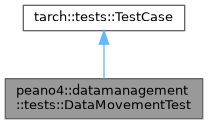
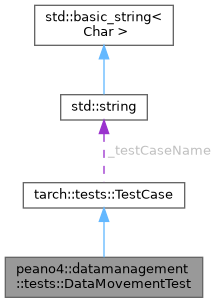
Test the function templates of VertexDataMovement.h, FaceDataMovement.h and CellDataMovement.h.
The tests use a small hand-written data type holding one integer, and an peano4::maps::STDStackMap over peano4::stacks::STDVectorStack. They build the traversal events by hand, i.e. they decide from which stack each vertex, face or cell is taken and to which stack it is written, and validate that the data ends up where the event says.
Definition at line 28 of file DataMovementTest.h.
| void peano4::datamanagement::tests::DataMovementTest::testVertexLoadAndStore |
( |
| ) |
|
|
private |
Load the 2^d vertices of a cell from the input stack, a temporary stack and as new vertex, then store them to the output stack, a temporary stack, or drop them.
Repeat the store with a flag which does not store persistently: the data on the output stack is then dropped, the data on temporary stacks is not.

 Public Member Functions inherited from tarch::tests::TestCase
 1.9.8