 |
Peano
|
|
Peano
|
Correctness checks of particle-mesh assignment. More...
Namespaces | |
| namespace | internal |
| namespace | tests |
Typedefs | |
| using | ParticlePosition = tarch::la::Vector< Dimensions, double > |
Functions | |
| std::string | sweepHistory () |
| Get the history of stored sweeps. | |
| void | startMeshSweep (const std::string &meshSweepName) |
| Inform API that this is the end of a grid run-throuch. | |
| void | eraseParticle (const std::string &particleName, const tarch::la::Vector< Dimensions, double > &particleX, const int particleID, bool isLocal, const tarch::la::Vector< Dimensions, double > &vertexX, const tarch::la::Vector< Dimensions, double > &vertexH, int treeId, const std::string &trace) |
| Log that a particle is erased. | |
| void | moveParticle (const std::string &particleName, const tarch::la::Vector< Dimensions, double > &oldParticleX, const tarch::la::Vector< Dimensions, double > &newParticleX, const int particleID, const tarch::la::Vector< Dimensions, double > &vertexX, const tarch::la::Vector< Dimensions, double > &vertexH, int treeId, const std::string &trace) |
| Record the movement of a particle. | |
| void | assignParticleToVertex (const std::string &particleName, const tarch::la::Vector< Dimensions, double > &particleX, const int particleID, bool isLocal, const tarch::la::Vector< Dimensions, double > &vertexX, const tarch::la::Vector< Dimensions, double > &vertexH, int treeId, const std::string &trace, const tarch::la::Vector< Dimensions, double > &prevVertexX, const tarch::la::Vector< Dimensions, double > &prevVertexH, bool particleIsNew=false, bool reassignmentOnSameTreeDepthAllowed=false) |
| Assign a particle to a vertex. | |
| void | detachParticleFromVertex (const std::string &particleName, const tarch::la::Vector< Dimensions, double > &particleX, const int particleID, bool isLocal, const tarch::la::Vector< Dimensions, double > &vertexX, const tarch::la::Vector< Dimensions, double > &vertexH, int treeId, const std::string &trace) |
| Remove particle from vertex. | |
| void | assignParticleToSieveSet (const std::string &particleName, const tarch::la::Vector< Dimensions, double > &particleX, const int particleID, bool isLocal, const tarch::la::Vector< Dimensions, double > &vertexX, const tarch::la::Vector< Dimensions, double > &vertexH, int treeId, const std::string &trace) |
| Assign a particle to a sieve set. | |
| template<typename Particle > | |
| std::string | pruneTypeName () |
| Find out particle name. | |
| void | eliminateExistingParticles () |
| Eliminate existing particles, so only those that are "forgotten" remain. | |
| void | ensureDatabaseIsEmpty () |
| Ensure that database is empty. | |
| template<typename ParticleContainer > | |
| std::vector< ParticlePosition > | recordParticlePositions (const ParticleContainer &container) |
| Record the current particle positions in a vector. | |
| template<typename ParticleContainer > | |
| void | traceParticleMovements (const ParticleContainer &container, const std::vector< ParticlePosition > &recordedPositions, const tarch::la::Vector< Dimensions, double > &vertexX, const tarch::la::Vector< Dimensions, double > &vertexH, int spacetreeId) |
| Trace the particle movements. | |
| tarch::tests::TestCase * | getUnitTests () |
| Please destroy after usage. | |
Correctness checks of particle-mesh assignment.
This API is inspired by ExaParty's exaparty::dependencychecks as introduced by Mladen: We keep some history of particle-mesh associations, trace new mesh assignments and validate them against the recorded history. All the tracing degenerates to empty routines if we work in release mode, so there should not be any overhead.
Most toolbox routines do automatically report against this API. However, to make the checks work, you have to report particle movements manually.
Furthermore, you might want to invoke toolbox::particles::assignmentchecks::startMeshSweep() prior to your traversals to ensure that you get a nice break-down of all mesh transitions.
By default, the assignment checks are enabled as soon as PeanoDebug is set to a value greater than 0. However, you can explicitly disable it by adding
-DnoAssignmentChecks
to your compile flags. This is important as assignment checks are very expensive. The checks also might yield invalid errors once you run them over multiple ranks, i.e with -DParallel.
| using toolbox::particles::assignmentchecks::ParticlePosition = typedef tarch::la::Vector<Dimensions, double> |
Definition at line 332 of file TracingAPI.h.
| void toolbox::particles::assignmentchecks::assignParticleToSieveSet | ( | const std::string & | particleName, |
| const tarch::la::Vector< Dimensions, double > & | particleX, | ||
| const int | particleID, | ||
| bool | isLocal, | ||
| const tarch::la::Vector< Dimensions, double > & | vertexX, | ||
| const tarch::la::Vector< Dimensions, double > & | vertexH, | ||
| int | treeId, | ||
| const std::string & | trace | ||
| ) |
Assign a particle to a sieve set.
To make this routine valid, the particle may not be assigned to a vertex anymore, i.e. detachParticleFromVertex() has to be called before.
| void toolbox::particles::assignmentchecks::assignParticleToVertex | ( | const std::string & | particleName, |
| const tarch::la::Vector< Dimensions, double > & | particleX, | ||
| const int | particleID, | ||
| bool | isLocal, | ||
| const tarch::la::Vector< Dimensions, double > & | vertexX, | ||
| const tarch::la::Vector< Dimensions, double > & | vertexH, | ||
| int | treeId, | ||
| const std::string & | trace, | ||
| const tarch::la::Vector< Dimensions, double > & | prevVertexX, | ||
| const tarch::la::Vector< Dimensions, double > & | prevVertexH, | ||
| bool | particleIsNew = false, |
||
| bool | reassignmentOnSameTreeDepthAllowed = false |
||
| ) |
Assign a particle to a vertex.
Take the particle, perform some consistency checks, and then add the particle event to our history database. The consistency checks differ for local from virtual particles.
In the scenario below, we illustrate the last scenario by means of an interface between two ranks. It is denoted below as grey partition (one left rank) and a blueish partition (on the right rank). They have kind of a halo layer of width one, which is a logical construct, i.e. not maintained manually.
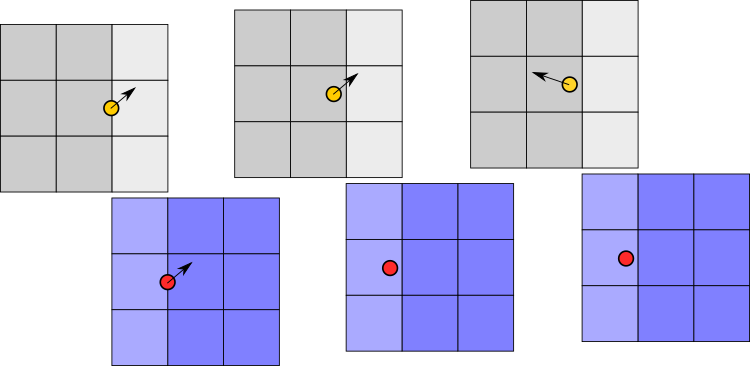
Study the central setup: In step N, yellow moves, while red will be deleted after the traversal, as each step moving particles has to update states as well (UpdateParallelState action set). Yellow now might be lifted to the next level. So far, its state is local on the grey rank, no matter if it stays within this subdomain or not. We exchange the data after step N.
In step N+1, either rank sets the state to local or virtual. This happens either in touchVertexFirstTime() in the UpdateParallelState action set, or it happens straight in merge(). No matter what, it happens on the coarser level before we even touch the fine mesh level. When we drop it, the particle has the correct parallel state.
Another special situation arises from a setup, where the particle of interest is located exactly along the subdomain boundary. In this case, we move both copies, as the particle is considered to be local on both ranks. Let one rank (tree 0) subsequently lift the particle, as it has moved quite a bit. The other rank (tree 1) therefore also has to lift yet cannot do so, as the next coarser mesh level is actually owned by tree 0. It adds its particle to the sieve set. After the movement, the particle is on the coarser level on tree 0 and in the sieve set of tree 1.
This sieve set is now exchanged between the trees. Tree 1 seems to be kind of simple: The particle will be taken from the sieve set, inserted into the domain (given that it hasn't totally left this tree) and will then either be set to local or virtual. However, we will also get a copy of this particle from tree 0 through the boundary. This copy will then be sieved. We end up with two copies: One from the global sieve set and one from the boundary.
Tree 0's behaviour exhibits the same behaviour: We will drop the particle which we have temporarily lifted to the next coarser level. After we have dropped it, we will also insert the copy from the global sieve set.
| prevVertexX | vertex coordinates of previous assiciation event. Needed to find particle in database after a detach event. If particle is new, it can be junk. |
| prevVertexH | same as prevVertexX, but for vertex size. |
| particleIsNew | If we know that a particle is new, there's no need to search through the database. |
| reassignmentOnSameTreeDepthAllowed | If true, assume our particle sorting/bookkeeping algorithm allows for a particle to be reassigned from one vertex to another vertex on the same depth in the tree directly (due to its movement). Otherwise, expect the particle to be sorted either via sieves or a sequence of lifts and drops. |
| void toolbox::particles::assignmentchecks::detachParticleFromVertex | ( | const std::string & | particleName, |
| const tarch::la::Vector< Dimensions, double > & | particleX, | ||
| const int | particleID, | ||
| bool | isLocal, | ||
| const tarch::la::Vector< Dimensions, double > & | vertexX, | ||
| const tarch::la::Vector< Dimensions, double > & | vertexH, | ||
| int | treeId, | ||
| const std::string & | trace | ||
| ) |
Remove particle from vertex.
To make this API call valid, the particle has to be assigned to a vertex beforehand. So there has to be a assignParticleToVertex() before this one.
| void toolbox::particles::assignmentchecks::eliminateExistingParticles | ( | ) |
Eliminate existing particles, so only those that are "forgotten" remain.
This routine runs through the particles for which we have recorded events. If the last event
we know that it cannot eliminate existing particles. So we remote their trajectories via removeTrajectory(). If the last snapshot is empty, we remove it completely.
Once this routine has terminated, we get the stuff in the database for particles that seem to have been left over. We also get a lot of historic data, but if we plot the database and study solely the last snapshot, we typically get a good idea of which particles got lost.
| void toolbox::particles::assignmentchecks::ensureDatabaseIsEmpty | ( | ) |
Ensure that database is empty.
This one is usually called after eliminateExistingParticles() and will leave the user only with particles which have "magically" disappeared.
This routine uses exit(-1) if no assertions are enabled.
| void toolbox::particles::assignmentchecks::eraseParticle | ( | const std::string & | particleName, |
| const tarch::la::Vector< Dimensions, double > & | particleX, | ||
| const int | particleID, | ||
| bool | isLocal, | ||
| const tarch::la::Vector< Dimensions, double > & | vertexX, | ||
| const tarch::la::Vector< Dimensions, double > & | vertexH, | ||
| int | treeId, | ||
| const std::string & | trace | ||
| ) |
Log that a particle is erased.
This should solely happen for virtual particles, i.e. halo particles. Before this function is called, the corresponding particle has to be removed from its associated vertex.
| tarch::tests::TestCase * toolbox::particles::assignmentchecks::getUnitTests | ( | ) |
Please destroy after usage.
| void toolbox::particles::assignmentchecks::moveParticle | ( | const std::string & | particleName, |
| const tarch::la::Vector< Dimensions, double > & | oldParticleX, | ||
| const tarch::la::Vector< Dimensions, double > & | newParticleX, | ||
| const int | particleID, | ||
| const tarch::la::Vector< Dimensions, double > & | vertexX, | ||
| const tarch::la::Vector< Dimensions, double > & | vertexH, | ||
| int | treeId, | ||
| const std::string & | trace | ||
| ) |
Record the movement of a particle.
We insert a new entry which memorises the particle movements. However, something we come across very often is that particles, once assigned to a vertex, very often stay assigned to the same vertex for a long time (=many sweeps) and only experiences small movements. Rather than tracing every single move event individually, the database will mark consecutive move events using a special event type, Event::Type::ConsecutiveMoveEvent. It will also keep track the original position of the particle, before the first move event of that sequence has occurred, as well as the current particle position.
In earlier versions, we tested for a previous event existing on any tree in the database. This lead to concurrency issues. Sometimes (on rare occasions) when a particle is being lifted or dropped in its local tree, these changes won't have made it into the database for trees where the particle is virtual as the trees will race over write access to the database. In these scenarios the checks will fail because they find that the particle hasn't been associated to the same vertex. Since we now keep track of a particle history for each tree it finds itself on, these checks are deprecated.
| std::string toolbox::particles::assignmentchecks::pruneTypeName | ( | ) |
Find out particle name.
In some places, it is convenient to construct the particle name from the type. However, some compilers only give you something similar to
which is really not what you want. This routine tries to reconstruct a meaningful result.
Definition at line 289 of file TracingAPI.h.
References assertion2.
| std::vector< ParticlePosition > toolbox::particles::assignmentchecks::recordParticlePositions | ( | const ParticleContainer & | container | ) |
Record the current particle positions in a vector.
| void toolbox::particles::assignmentchecks::startMeshSweep | ( | const std::string & | meshSweepName | ) |
Inform API that this is the end of a grid run-throuch.
Delegates to the corresponding method in the database.
| std::string toolbox::particles::assignmentchecks::sweepHistory | ( | ) |
Get the history of stored sweeps.
| void toolbox::particles::assignmentchecks::traceParticleMovements | ( | const ParticleContainer & | container, |
| const std::vector< ParticlePosition > & | recordedPositions, | ||
| const tarch::la::Vector< Dimensions, double > & | vertexX, | ||
| const tarch::la::Vector< Dimensions, double > & | vertexH, | ||
| int | spacetreeId | ||
| ) |
Trace the particle movements.
This routine runs through the particles in container and invokes moveParticle() for each and every particle which has moved. That is, we assume that recordedPositions has been obtained through recordParticlePositions() before, and both recordedPositions and container hold the same particles in the same order (even though they might have moved in-between).
We only record particles that have moved, but actually the comparison here is only an optimisation, as the moveParticle itself will once again check that the particle has actually changed its position.
We skip the checks for virtual particles. Virtual particles may end up here during a lift operation: They have been moved on a lower level and are now in the process of being lifted. In these cases, the checks we have set up fail, as the particle being lifted is not assigned to the correct vertex any more. Skipping these checks is fine because these virtual particles have already been moved while they've been Local, and the appropriate event has been noted and checked beforehand. Other virtual particles, i.e. virtual particles that have been virtual even before the move operation, should never have been part of the assignedParticles list that is being looped over.
 1.9.8