 |
Peano
|
|
Peano
|
Besides the actual vertex/face/cell data your solver attaches to the mesh, Peano's core continuously tracks a small set of statistics about the mesh itself while it traverses it: how many cells are refined vs unrefined, whether the mesh still changes, how fine the finest cells currently are, and so forth. These data live in peano4::grid::GridStatistics.
operator+ (src/peano4/grid/grid.cpp), which adds up the counters, combines the flags with a logical or and takes the minimum of the mesh sizes.operator+ as reduction operator, and stores the outcome. Without MPI, this step degenerates to a plain copy.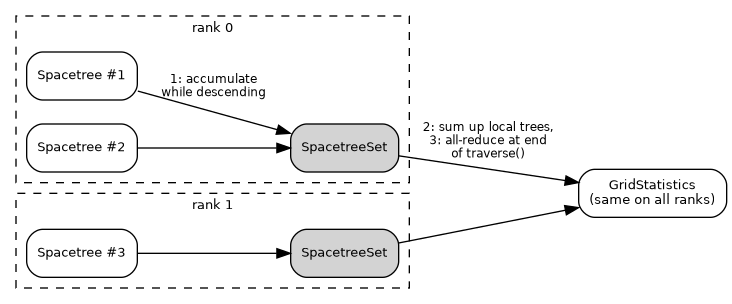
peano4::parallel::SpacetreeSet::getGridStatistics() returns the reduced statistics, i.e. the same values on every rank. They describe the whole mesh after the most recent traversal. As every rank runs traverse() at the same time, the reduction is safe, and decisions taken on the statistics, such as peano4::grid::isGridStationary() in the repeat condition of a mesh refinement step, are the same on all ranks. Before the first traversal, getGridStatistics() returns the statistics of the local trees as set up by peano4::parallel::SpacetreeSet::init().
If you need the statistics of one individual local tree, use peano4::parallel::SpacetreeSet::getGridStatistics(int) const. These are not reduced.
The statistics can be read out through the spacetree set:
A common place, where this is used, is the default step reporter peano4::DefaultStepReport::reportStep() which you can use as a starting point for your own use of the stats:
exahype2.api.fv.actionsets.ComputeGlobalCFLCondition (src/exahype2/api/fv/actionsets/ComputeGlobalCFLCondition.py) is a worked example: it reads the finest mesh size from the statistics and combines it with a solver-tracked maximum eigenvalue into a globally admissible CFL time step size.
The statistics of the whole mesh are already reduced. If you assemble a GridStatistics object yourself, e.g. from the statistics of some individual trees, peano4::grid::reduceGridStatistics() combines such an object over all ranks. It is a blocking routine which every rank has to call at the same time, so only call it from somewhere that runs once per rank at a well-defined point, such as a static prepareTraversal()/unprepareTraversal() (
Not everything you might want a global view of lives inside GridStatistics. exahype2.api.fv.actionsets.ComputeGlobalCFLCondition's maximum eigenvalue is a plain double the solver accumulates itself (guarded by its own static tarch::multicore::BooleanSemaphore while several trees/threads on the same rank may still be writing it). For a plain scalar like that, use tarch::mpi::Rank::getInstance().allReduce() directly, guarded by #ifdef Parallel (the call needs MPI-specific types that do not exist in a non-MPI build). Do not call raw MPI_Allreduce directly: tarch::mpi::Rank::allReduce()'s own documentation explains why a literal blocking allreduce risks deadlocking Peano's asynchronous message exchange, and what the waitor callback (tarch::services::ServiceRepository::getInstance().receiveDanglingMessages() in the example below) is for. As tarch::mpi::Rank::allReduce()'s documentation requires, only one thread per rank may call it.
toolbox::loadbalancing::Statistics mirrors the grid statistics: its updateGlobalView(), which every load balancing strategy invokes in its finishStep(), all-reduces the load balancing's own data over all ranks via tarch::mpi::Rank::allReduce() - the global number of trees, how many ranks currently have load balancing switched on, the global number of splits, and the maximum number of trees held by any one rank. The reduction is blocking, so all ranks hold the same values afterwards. Only the data explicitly labelled as local, such as the number of splits a rank has triggered itself, remain rank-local.
toolbox::loadbalancing::CostMetrics follows the same pattern: its updateGlobalView() all-reduces the global weight, the lightest rank and the minimum of the rank weights with blocking reductions.
The load balancing statistics do not provide cell counts. Strategies which need the global number of cells read it from peano4::parallel::SpacetreeSet::getGridStatistics(). The load balancing however also needs the weight of each individual rank, which the reduced grid statistics do not provide. The strategies and toolbox::loadbalancing::metrics::CellCount::updateGlobalView() therefore sum up the number of local unrefined cells over the rank's local trees via peano4::parallel::SpacetreeSet::getGridStatistics(int) const.
 1.9.8